


The Wellness System
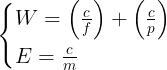
Move Beyond Healthy Eating. Use Math to Promote Wellness. Come take part in this revolutionary new way to lose weight and feel better. Using this one simple formula, you can change your life for the better forever.



By downloading you agree to our Legal Disclaimer.
Get Ready for The Wellness System
For the first time in human history, we have the entire world at our fingertips. We live in a fast-paced, sedentary society where the phone steals our attention. This results in less mobility and contributes to obesity and overweight. According to the WHO, obesity has already reached epidemic proportions globally. Even more alarming is the rise of childhood obesity which is already epidemic in some areas and on the rise in others.
The purpose of The Wellness System is to battle the obesity epidemic head-on by using applied mathematics. By creating mathematical structures and portioning them out in the form of food, you can gain control of your eating habits and therefore are able to more clearly set goals and build strategies to attain wellness in all areas of your life.
This ebook will give you all the knowledge you need to be successful in your nutrition and weight loss journey. The simple system of formulas will empower you to eliminate the unknown in your diet and to become the master of your own body, the ultimate weapon in the battle against obesity.
Visit the forum to take part in this revolutionary way to lose weight and feel better. There you can download the worksheet and extension files and find additional information. Of course, you can always email me at twsbhe@gmail.com.The Birth of The Wellness System
No one remembers the beginning of choosing foods. Our parents serve as our diet. They decide for us and teach us which foods to choose. At some point in our youth, we begin to understand that food is a problem that must be solved by us alone. We must let go of what our parents instill in us in order to embrace our own solution to food. Sometimes, we choose to subscribe to someone else's solution which is what a diet is all about. Other times, we create our own diet through careful trial and re-factorization, for everyone reacts to food differently.
We follow diets and nutritional plans because we don't understand food and eating. We get confused and scared by the vast amount of information at our disposal, and this drives us to try and make sense of that information. Many times, different sources have conflicting information and prevent us from coming to our own conclusions. This leads us to dieting; a belief that by following a program of inclusions and exclusions, we are doing what's best for our body.
Science and medicine have always been correct, but that which is correct hasn't always been the truth. For example, back in the 1700's, letting blood was thought to rid the body of pathogens. For my generation, doctors always told us that high-fat diets were the cause of obesity. Of course, now we know that blood-letting is harmful to the body and high-fat diets are not the only thing that leads to obesity. Indeed, I wonder what science will reveal in the future about what we know at present. If I had to guess, we eat too much animal protein. Even though this isn't specifically a Vegan system, you will find the problems associated with animal protein and how to overcome them. Instead of scientific papers about metabolic pathways, dozens and dozens of nutrients, and what happens in the colon, this system is about something very simple and incredibly powerful: wellness.
We all have a notion of the word 'wellness'. The dictionary defines 'wellness' as, 'The quality or state of being healthy in body and mind, especially as the result of deliberate effort. This definition is close to the definition that we will explore in The Wellness System. We will discover this concept of wellness as it is related to the food that we eat and the liquids that we drink. But first, I will explain how I became aware of my own quest towards wellness in body, mind, and spirit.
When I was fourteen, over the summer, I was employed by my grandfather in his office writing pamphlets and managing attendance sheets. I also dabbled in email routines and computer programming, which eventually led me to study computers in college. Every day for lunch, I would walk down to the local burger joint and get three chili dogs with onions. I never really thought much of it. I ate delicious foods and they gave me energy. Before I knew it, I looked in the mirror at the end of the summer, and I had gained a considerable amount of weight. That was the moment in my life where I realized that I couldn't just eat whatever I wanted.
When I went back to school in the fall, I wasn't prepared for the consequences of my decisions. I was totally alone because of my weight. I remember in gymnastics class, I would get up and do the floor exercises (those were my favorite), and everyone would laugh at me and call me fat. I ended up changing schools to escape the teasing.
I also developed a problem with acid reflux. After it got really bad, I went to the doctor and he prescribed a medicine to help. After a few weeks of taking the medicine, it started to work a little. But I still had problems with stomach acid. I remember thinking, 'All this because of chili dogs.'
I spent the next two years overweight and trying to eat more healthily. I knew which foods were healthy according to my parents, but for some reason, I couldn't bring myself to eat those foods. Most of us remember the early lesson our parents teach us: 'eat your vegetables'. Even though this is in some sense useful, it's only when we discover why this is true that it becomes easier to follow. Without realizing it for ourselves, it is not maintainable in the long-term.
It was in highschool that I really began to try and modify my diet for long-term success. One day, one of my teachers told us about his all-meat diet. It sounded simple and easy to maintain, so I decided to try it for myself. I knew that having a steak every night was too expensive for me, so I turned to canned tuna fish. I would mix a little mayonnaise with the tuna, add some cheddar cheese and sage, and pop it in the microwave for a minute: I called it Spuna. This was my first attempt to seek out my own personal truth in food and eating. Looking back, I'm not sure why I reasoned that Spuna lead to wellness. I suppose I thought that tuna was healthy and the rest was just for taste. I must say, I do believe that it helped me to lose some weight, but it wasn't sustainable. I went back to eating regular foods, but retained a high-protein element in my diet.
I continued this diet through college. Since I lived in dorms, we had a cafeteria environment, so I wasn't able to do a lot of cooking. However, I did all that I could to avoid carbs, especially bread. For example, I would grab four chicken sandwiches and simply throw away the bread. I always felt bad about wasting food, but I learned that eating healthy foods sometimes meant throwing out unhealthful components. Aside from the cafeteria, I ate fast food a few times a week. I was able to maintain a healthy weight because I was burning so many Calories in a day. So a mild low-carb diet was enough for me to get through those years of my life.
After college, I continued this pattern of maintaining but slowly started to put on weight. I wasn't doing as much walking and exercising, though, I was working 8-5 which restricted what I could eat. I would go with my coworkers to lunch and order burgers. I spent lots of money eating out or getting delivery. And still, I continued to slowly gain weight.
After a while, I began to notice my weight gain creeping up on me. So I decided to do some research and come up with a good solution. I read a couple different books, all with different concepts. The one that stood out most was a book about anti-inflammation. I greatly identified with the book's ideas; food is either medicine or poison depending on whether it causes inflammation or anti-inflammation in the body. Unfortunately, the algorithm used to determine anti-inflammation wasn't revealed in the book, so I was unable to apply it to foods in the grocery store. It also used numbers to describe the healthfulness of individual foods. This is when I was first acquainted with metrics being applied to food's healthfulness.
After realizing that food could be seen as medicine, I took steps to improve my diet. I applied the ideas in the book to my life. This is also when I learned about the glycemic index, a number that could loosely estimate the impact of a food on the body. My diet went from soup and sandwich to seaweed and fish. I did this for a good while, but I never really lost significant weight or felt any better. However, I was inspired by these metrics, a simple yet powerful way of describing foods. This was the birth of The Wellness System.
After some major life changes, I moved back to Raleigh. At first, I wasn't working and my weight grew considerably. I went from 190 lbs to 250 lbs over the course of 5 or 6 months. My normal diet stopped working, mostly because I ate for comfort. I felt lost and out of control, and I didn't know what to do. I finally began to see my obesity as an enemy, and began devising ways to battle my weight.
So I became a Vegan, in hopes that this might be the solution for me. I stopped eating animal products and began to feel better over time. At first, my weight went down and then stopped. I thought maybe I was still eating too much, so I tried eating smaller portions. That didn't work for me either. I got tired of eating Tofu and wheat meat. Eventually, I wasn't able to sustain Veganism.
I went back to eating whatever I wanted, but I tried eating smaller portions. This didn't work either and I remained around 240 lbs. I stayed at this weight for a good 9 months. I started having serious stomach problems, so I decided to continue my search for something new.
I started by seeking help from a doctor. After listening to my problems, the doctor diagnosed me with IBS, a fairly common GI disorder. She gave me a special medicine that was supposed to fix my GI problems and told me to take a daily fiber supplement. So I did both of those things for 2 weeks and felt no change in my body. I knew there was something wrong with what I was putting into my body, and I knew if I solved my problem of food, I would eliminate obesity.
So I went back to the doctor and told her I didn't want to continue taking the medicine. Then, I decided to focus on my food. I started by cutting out all sugars and carbs, no more starch, pasta, rice, sweets, etc. I was eating meat, veggies, and fruits. The second day after starting this diet, I felt a drastic change in my mood. I felt really good, and I knew that my diet was the difference. I continued on this path and was able to sustain it. Over the course of 6 months, I was able to drop 20 lbs and got down to 220 lbs. Even though this was a victory for my weight, I knew it wasn't the diet I was looking for, because my GI problems persisted and my weight plateaued. But I stayed on this diet because it was the closest I had gotten to wellness. I had faith that my perfect personal diet existed and that someday I would find it and help others to find theirs.
My weight stayed the same over the course of a year. I tried adding a daily smoothie to boost my fiber intake as well as a fiber supplement. This helped me a little. I noticed a change in my mood on the days when I had a smoothie, but I still felt like I was missing something. I knew that there had to be a simple yet elegant solution that would help me determine which foods made me feel good and which foods didn't. Little did I know that the solution was right under my nose.
I had been on a high protein, low-Calorie, low carb diet and, after testing smoothies, added high fiber. So I decided to explore the relationship between Calories, fiber, and protein. I knew I wanted Calories to be low and fiber and protein to be high. This can be described mathematically in the form of ratios. So I created formulas that estimated the values of a food product, based on these three variables: Calories, fiber, and protein. We can apply these metrics to foods in order to estimate their effect on your well-being. I began calibrating the formulas and making sure they worked properly. I went to the grocery store and spent many hours applying these metrics to every food I could find. Everything seemed to be an accurate estimation; vegetables have the highest value, followed by fruits, whole grains, meats, etc.: Could I have found the solution I'd been looking for?
I decided to try this on myself and began eating foods that were considered to have the highest nutritional value according to the metrics. Almost immediately, I started to feel better, have more energy, and sleep more soundly. It fixed all of my stomach problems and helped me to exercise better. I couldn't believe it; I knew I had found the solution that I had been searching for for many years.
After a few days, my body went through an adjustment period I call 'turning the corner'. I had been used to eating large amounts of animal protein. My body had to get used to eating smaller portions of meat and eating more plants. After about 5 days, I was acclimated to the plan and felt better than I had felt since high school. One thing that stood out to me was the simplicity of maintaining; for lunch, you can have a can of beans (very cheap) and feel fuller than having a burger (not so cheap). You are getting greater nutritional value for a lower price (cost value).
In fact, food quality and nutritional value is the cornerstone of The Wellness System. You will discover how to determine the nutritional value of any food with a label. You will also learn to estimate the wellness of a composite of resources using structures. Though, some of this info will be familiar, like most veggies are great to eat, some of it will be new to you, like low-fat yogurt has higher protein value than chicken.
In order for us to conquer the problem of obesity, it is going to take hard work and time. That is what TWS does for anyone who chooses to put effort into making structures and creating meal plans; you will get out of it what you put into it. For, vanquishing obesity starts with the individual first.
General Information
The Wellness System is a form of holistic health. The purpose of The Wellness System is to eradicate obesity world-wide by helping you discover your own personal food strategy (diet) and lead you towards a state of wellness in body, mind, and spirit. Everyone is a unique individual and will require a different strategy. TWS uses spreadsheets in order to organize info about your diet, interpret that information into meaningful analysis, and help you to create lasting change in your eating habits. These steps are repeated in a cycle until you find the strategy that best suits your body. The system is not automated and requires physical effort on your part to create structures and organize resources. However, this is a good thing because you will learn about your habits and how to discover your own strategy. There are a few things you will need in order to get started with The Wellness System:
- A desktop or laptop computer. You will be copying and pasting formulas and this doesn't work as well on cellphones. You can still use a phone, but it will be slower. If you don't have anything, I recommend getting an inexpensive Chromebook by Google. This will also give you access to Sheets for free
- The Wellness System Worksheet
- A spreadsheet application that can open *.xlsx files (I use Google Sheets)
- A calculator (I use Desmos.com/scientific)
- A grocery store close by
- A food scale to measure your portions
- Your BMR or how many Calories you burn in a day without exercise (you will need this info to help calculate your Calorie deficit). You can find websites that estimate your BMR.
- Knowledge of basic arithmetic and spreadsheet formulas
- Time. You must find time to create structures. You will get out of this system what you put into it
- Patience and perseverance. TWS is about making a long-term commitment to achieving wellness in your body, mind, and spirit
This system is based on resources (food or drink consumables). These are the axioms, the basic building blocks that you will use to create structures. A structure is a set of resources organized in a meaningful way. By studying the structures that you make, you will learn about your eating habits. This will help you to modify your eating habits in constructive ways.
The Wellness System is a meta diet which means it helps you find your own food strategy; every set of inclusions will be personal. In other words, the path to wellness looks different for different people. Diets tell you what to eat and what not to eat. Instead, TWS helps you to understand your diet (whatever it might be) and make changes to improve your overall wellness. For example, a Vegan can benefit from TWS by understanding the fiber value in their diet. A paleo diet can benefit from TWS by learning the energy density and protein value of different meats.
Compatability Notes
The Wellness System uses spreadsheets in order to help you organize your strategy. The system worksheet is contained in a *.xlsx file and can be opened in Google Sheets, Microsoft Excel, and most other spreadsheet programs. For those who do not have spreadsheet software, a free Google account will give you access to Sheets. There are some compatibility issues between Sheets and Excel:
- Colors don't match
- Ghost lines
- Functions don't always map the same
The Wellness System is very simple and only uses basic arithmetic. Even still, you need to use the correct function in order to be compatible with both applications:
This will ensure that your system worksheet will be cross-compatible.
Be careful when switching between Sheets and Excel. The coloration will be lost when you open the file in Excel and again in Sheets.
Also, most of the images will be too small to see as is. All you have to do is alt click or right click and select 'open image in new tab' and you will be able to see the numbers.
Long-term Health
Our diet is one of the biggest factors to our long-term wellbeing. Infact, the resources we eat and drink become a part of our bodies and over time shape our health.
Eating one fast food meal is not going to affect your long-term wellness. However, eating fast food every day for years will take a negative toll on your body. Similarly, if you jump between diets but keep going back to fast food, this will not have a positive effect on your wellness. The goal of The Wellness System is to empower you to find your own eating habits such that they have a positive, long-term effect on your body, mind, and spirit.
The system allows you to choose the pace at which you will lose weight. Research has found that weight lost over time tends to stay off compared to rapid weight loss which is often gained back quickly.
Regarding nutrition, quickly adding it to your diet can have an immediate, positive effect on the body. Some nutrients like Vitamin D require supplementation and take time to build up. Maintaining a high nutritional value in your diet over time is one of the best ways to fight disease and aging .
Overall, don't expect TWS to be a miracle weight loss pill that happens overnight. It is a long-term journey towards wellness that demands patience and perseverance. Don't give up, and you will see results!
Eating Habits
We all settle into a routine with regard to our food and maintain this pattern of behavior over time. In fact, changing this behavior is relatively simple, however maintaining it is often difficult. Just as we learn in school, 'An object in motion tends to stay in motion,' so does a pattern of behavior perpetuate itself and resist change. This is why fad diets never work for long. The previous pattern of behavior still exists. It is simply suppressed for a while.
Is there a way to modify a pattern at the root creating lasting change? Yes there is, and TWS is one way of unlocking this power.
TWS is organic and able to grow alongside you. If you have restrictions with your diet, you will be able to find new foods. Because TWS is adaptable, it will always promote the vision of continually approaching an ideal state of physical, mental, and spiritual wellness.
Promote Self-awareness
Self-awareness is needed for success with TWS. A diet without self-awareness will likely fail because it cannot change, and if your diet cannot change, it cannot last.
Self-awareness is needed to intuitively understand your food strategy. An intuitive grasp of your strategy will save time and promote longevity.
Boost Nutrition
Nutrition is one of the biggest problems with the average diet. Most people do not get enough fiber, and high-fiber foods tend to have more vitamins and minerals. Fiber is like the oil in a car; it keeps the engine running smoothly. On the other hand, most people in the US get enough protein in their diet because of our high consumption of meat.
According to TWS, fiber and protein are the two most important nutrients. In fact, they are the only nutrients used in tracking (in TWS, Calories are not considered nutrition). Foods that have both of these are considered to have more nutritional value. However, you can also achieve the same effect by selecting one food with only fiber value and another with only protein value. This is called a complementary pair.
Lose Weight
Losing weight is why most people decide to diet. It is associated with a lot of good things. However, few people are successful in the long-term; they subscribe to a diet until they can't sustain it anymore.
Because TWS is adaptable, you will find it easy to maintain. For example, in using the system, I have noticed that my body needs very little amounts of food and water to function. This led me to focus on restricting my portions first, and boosting my nutrition second. This ensures that I don't get into a vicious cycle where I eat too much nutritious food; eating too much of a good thing can lead to weight gain.
Once you use the system for a little while, you will develop your own strategy for losing weight. Overall, remember weight loss takes time. Eat fewer Calories than you burn. As long as you keep up your Calorie deficit, you will succeed!
Interpreting the System Worksheet
Expression Types and Resource Behavior
This tab is a reference for resource classification and interaction. Learning how to put certain resources together will help you balance your composites.
Resources Integration
In TWS, all quantities are measured in grams. This tab is a reference for converting cups, ounces, and fluid ounces into tempered or exact grams. It is separated into two charts, the first is for dry goods, the second for aqueous substances.
The Resources Map
This is the main resources reference sorted by nutritional value and/or energy value. Use this to help you decide what to consume.
The Personal Resources Map
This reference is your personal resources map sorted by nutritional value and/or energy value. Use this to import resources.
The Definition Library
Use this tab to create nested resources for reuse.
The Archive
Use this tab to store the structures you build. Once you accumulate structures, you can search them for reference. The archive has templates at the top for you to copy and paste. You should never have to build a structure from scratch. Just copy and paste the template (or other structure) you want and restructure it with new resources.
The Whiteboard
This is where the fun happens. Use this tab to build structures that match your personal needs.
Extensions
An extension is a way of enhancing TWS by adding additional, measurable parameters to the defaults. An example would be a Caffeine Content extension.
Beyond Healthy Eating
'Healthy' is a word that can mean many things. By reading the Relativity of Impact Proof, you can see the problem with the concept of 'healthy' eating. How can a resource be both healthy and unhealthy?:
We need to get away from the idea that there are 'good' foods and 'bad' foods. For example, for the average person, peanuts might be a great source of protein and fat. However, for someone who is allergic to peanuts, it could be deadly. This is an example where a resource can be either good or bad depending on whose eating it.
Also, healthy can depend on your body chemistry. A person who is metabolizing carbs should count their calories so the insulin in their body doesn't store excess calories as fat. This means that a person eating carbs should avoid high Calorie foods like nuts. However, if a person's body is in Ketogenesis, they will need a large amount of fat in their diet in order to metabolize properly. Depending on your body chemistry, high fat foods can be either 'unhealthy' or 'healthy'.
In TWS, even the 'bad' foods can have a purpose. For example, most 'bad' resources are energy dense. They often have a lot of protein value. So eating energizers with nutrions together creates a complementary pair that contains protein, fiber, and nutritional value: a synergy greater than any individual resource by itself.
We can describe any individual or group of resources as healthy based on their W and E metrics: a W below 80 and an E below 1 is considered healthy. For example, blackberries alone are healthy, and brown rice by itself is unhealthy. Blackberries and brown rice together in the proper proportion can be healthy, and blackberries and brown rice out of proportion can be unhealthy.
Why Traditional Diets Fail
Dieting is something most people have experienced. Most of us have at one point attempted to eat more broccoli or refrain from eating too many cookies. There are many diets out there, each with a proposition about what is considered 'healthy' to eat. Some claim only vegetables is the way to go, others only meat, others a mixture of the two, and others exclude certain nutrients or types of food altogether. Most doctors will tell you that a diet high in whole fruits and vegetables, lean proteins, and low sugars or carbs is the way to go. But how come, no matter how many times your mother told you to eat your vegetables, you can't seem to stick to a diet plan in the long run?
This is because traditional diets are not designed for your body. Diets are a way of simplifying the problem of nutrition by formalizing a set of exclusions and inclusions to assist you in making healthful choices. For example, on an all animal meat diet, spinach is an exclusion, however on an all vegetable diet, spinach is an inclusion. But how can spinach be both healthy and unhealthy? These diets are often in conflict with one another which leads to confusion and prevents us from discovering our own personal food strategy and leads to obesity.
We can think about a diet as a decision problem. This problem has three components, the input, the algorithm, and the decision. In the case of a diet, the input is the food in question, the algorithm is a way of coming to a decision based on any number of factors, and the decision is the result of the algorithm.
Now, the algorithm analyzes the input and determines the decision. The problem with this approach is when a single input can produce both yes and no. For example, with peanuts as an input, a traditional diet might decide that nuts are healthy. However for people who have a peanut allergy, the algorithm's result would be harmful. This shows us that the diet as algorithm model is fundamentally flawed, fundamentally undecidable.
The problem of weight is massively complex with many variables. Eating two things at once will be digested differently than on their own. Cooking food will change how it is broken down in the body. The time of day that you eat it will change the outcome. Even smelling food prepares the digestive system for a meal so it can be digested better. To the body, every piece of kale is a new and different problem, every meatball a puzzle.
Diets tell you what to eat. The simplest diet that most of us remember from childhood is 'eat your vegetables'. But what about Yucca Root? This vegetable has low nutritional value and further illustrates the problem of undecidability. We tend to divide groups into subgroups and subgroups even further, for example, carbohydrates is a group, fiber is a subgroup. We have sweets, fats (saturated and unsaturated), meats, beans, fungi, etc. Trying to diet based on groups and categories is setup for failure because there are always exceptions.
The traditional diet model is to define a set of inclusions and exclusions, portions, or preparations. People then make the decision to follow the diet hoping that it will bring them health. The problem with this approach is that all bodies are different. One diet might work for one person but not for another. The Wellness System is all about helping people to create their own personal diet that fits their body best. This is done by starting with your current diet, analyzing tracked data, and refactoring your diet. As you run into walls, you can continue this cycle until you start to find a set of resources and structures that work for your body. Your own personal food strategy will slowly emerge from your efforts, and your personal victory is a victory against obesity everywhere. TWS can also accommodate other diets, for example, someone on the Keto diet can use TWS to ensure nutrition value without giving up their diet.
The Wellness System will help you to make decisions without telling you what you should or shouldn't eat; you decide for yourself what you eat. For example, some people are sensitive to gluten and can't eat dense breads. TWS will help them to find other sources of protein. Others can't eat too much fiber without feeling sluggish. TWS can help them to find foods with less fiber value while still getting enough fiber. Everyone's ideal diet is different and everyone's diet will change over time. The Wellness System is a map designed to help you along your food journey. If you diligently follow the system, you will discover your own food strategy. Don't be surprised if your strategy changes, for this is normal, and TWS is designed to adapt to your changing needs. It will take some effort on your part, but you will get out of it everything you put into it. By the time you download this system, you will be well on your way to achieving wellness in your own life.
Keto
The Ketogenic Diet, or Keto, is a low carb/high fat diet similar to Atkins. It emphasizes maintaining a state of ketosis in the body brought about by eating very little carbs and replacing it with fat. They body then burns the fat for energy instead of carbs. Keto dieters focus less on counting Calories and more on eating foods that maintain ketosis, high fat, medium protein, and low carb.
On the Keto diet, your metabolism is altered which allows you to eat foods that would otherwise be problematic. However, many people forget that the body still needs a source of fiber. TWS can help you find sources of fiber to augment your diet. Thus, keto can be considered a high fat, high fiber, medium protein, low carb diet.
Here is an example Keto meal:

As you can see, this meal is high in protein value and high in fat, indicated by the E. This is desirable when you are metabolizing fat instead of carbs. However, there is very little fiber. We can boost the fiber by adding a high fiber value food that is also low in carbs like blackberries.
Here is the same meal enhanced with TWS:

South Beach
This diet is based on high-fiber, low-glycemic foods. It also promotes the intake of lean protein and 'healthy' fats instead of 'unhealthy' fats. It prohibits anything with a high glycemic index or foods too low in fiber. The plus is that high-fiber diets tend to be more filling and low-glycemic foods have a smaller impact on the body's insulin response. The minus is, it's not flexible, it's more difficult to lose weight, and it can be expensive.
South Beach dieters can apply TWS to help them make decisions about which foods have a low glycemic index as well as high nutritional value. By choosing foods with both, you are increasing the quality of your food strategy.
Here is an example of a South Beach meal:

As you can see, this meal has lean meat, vegetables, and a salad. It has a low number of Calories which is good for weight loss. However, it has low fiber value which translates into low nutritional value. The energy factor is close to 1 which translates into a lower energy value. This could be improved by using a low/no Calorie dressing and by adding a strong source of fiber value like blackberries.
Here is the same meal enhanced with TWS:

Sprinkle Diet
The sprinkle diet is based on the idea that by making the body feel full, you can prevent weight gain. To make the body feel fuller, you sprinkle tiny crystals on your food, inducing satiety. This diet includes the sprinkle crystals and whatever else you want to eat. There are no exclusions. The plus is you get to eat what you want. The minus is it masks the real problem which is choosing more fiber rich foods to feel fuller. This doesn't promote overall wellness.
Since sprinklers have all inclusions, technically it is not a diet. Like the no-dieters, they can use TWS to begin fashioning their own diet by carefully selecting the better options while still eating for pleasure. This will help them to feel fuller and could result in the discontinuation of the sprinkle diet.
Here is an example of a Sprinkle meal:

The problem with the sprinkle diet is it encourages you to eat what you want without any regard to nutritive value. The meal above is a typical meal for sprinkle dieters. Even if you can't finish your food (because of the sprinkle), you still aren't getting the nutrition your body needs. You can see the composite row has low value across the board. Below is another meal created using TWS minus the sprinkle and with greater nutritional value.
Here is the same meal enhanced with TWS:

Raw Foods
The goal of a raw foods diet is to eat food in its natural state to prevent nutrient loss that comes from processing or cooking. Like the CR diet, raw foods is a lifestyle. It includes whole, natural foods that haven't been processed or cooked. It excludes everything else. The plus is you get more nutrition. The minus is it's hard to maintain.
Raw food dieters can apply TWS to help them make decisions about which foods have greater nutritional value. This is important since there are so many exclusions in their diet.
Here is an example Raw Foods meal:

This raw foods meal has some major problems. First, walnuts have very little nutritional value which drags the composite down. Second, apple has a low nutritional value because of its lack of protein value. The simplest way to fix this is to replace walnuts with almonds. You can eat more almonds for the same number of Calories, and they have greater nutritional value. This raises the overall value of the composite.
Here is the same meal enhanced with TWS:

Mediterranean Diet
Based on the diets of the people who live there, the Mediterranean diet includes whole fruits and veggies, whole grains, beans, nuts, oils instead of butter, fish and seafood, poultry, egg, and cheese. It excludes sweets and red meat. The plus is by cutting red meat and eating fruits and veggies, this is an overall effective diet. The minus is, you can eat too much meat and not enough veggies. Also, some fruits, veggies, grains, and nuts have low nutritional value, because they are Calorie-dense.
Mediterranean dieters can apply TWS to help them make decisions about which foods have greater nutritional value. This will help them avoid empty Calories and maximize the fiber and protein in their diet.
Here is an example Mediterranean meal:

The Mediterranean Diet has a lot of good things about it, but like most diets, there are some less successful resources and structures. This meal above has almost no value except for energy value attributed to water. Below is an application of TWS to the meal above. Sticking to the types of foods, hummus has more value than tabbouleh, and whole wheat tortilla has much more nutritional value than pita.
Here is the same meal enhanced with TWS:

Low Fat Diet
This diet is based on the concept that eating fatty foods will increase the storage of fat in the body. In order to lose weight, you must rid fatty foods from your diet, especially saturated fats. It includes all low-fat foods and excludes all high-fat foods. The plus is by getting rid of fat, you are erasing empty Calories and this can help you lose weight over time. The minus is that there are many low-value foods that are fat free, especially refined carbs and sugars. Also, we know now that refined carbs and sugars are just as much a cause of weight gain as fatty foods.
Low fat dieters will find that TWS can help them stick to low-fat foods since fat is simply Calories without protein or fiber. In fact, according to TWS, all fats and oils are considered incomplete resources and should be eaten only on occasion or in small portions.
Here is an example Low Fat meal:

Overall, the Low Fat diet and TWS have a lot of similarities. The formulas for TWS are designed such that fats and oils push the nutritional value of a resource down. This doesn't mean you can't eat fat. You need fat in your diet, but only in small portions. The above is a low-fat breakfast. It has high fiber value, low protein value, and overall low nutritional value. Three simple edits can improve this breakfast. First, make your oatmeal with soy milk (soy milk has the most nutrition of all the milks). Second, replace bananas with unsweetened cocoa powder for a big dose of nutrition without the carbs. Third, dilute your juice with water.
Here is the same meal enhanced with TWS:

Juice Diet
This diet has been trendy for awhile, promoted by popular celebrities who swear its authenticity. The idea is to deliver nutrition directly to your body by combining juices from different fruits and veggies. This saves your body the extra work of breaking down foods. Even though this diet isn't intended to be long-term, many people doubt its ability to deliver what it claims. The plus is that it may help you get some nutrition. The minus, protein and fiber are scarce. Also, it can be expensive and you may not lose any weight at all.
TWS can help juicers to determine which fruits and veggies have the smallest number of Calories. Since juicing removes the fiber and protein, choosing low-Calorie juice and supplementing fiber and protein is vital to your long-term success.
Here is an example juice meal:

In this example, I've reduced the fiber and protein by half to simulate the juicing process (juicing doesn't remove everything). The best thing about this is the energy value. Since these foods must be juice-friendly, there are a large number of exclusions on this diet. I modified this juice below by choosing juice-friendly foods with a high nutritional value. This helps to recover some of the fiber and protein lost during juicing.
Here is the same meal enhanced with TWS:

Paleo Diet
Paleo seeks to solve the problem of food by examining the origin of homo sapiens. It purports that our bodies have evolved over time to process certain foods better than others. It includes veggies, fruits, nuts, and meats, and excludes dairy, grains, and legumes, along with man-made, processed foods. The plus is that it includes fruits and veggies. The minus is that there are many exclusions, even foods with nutritional value, like whole grain pasta.
Paleo dieters can apply TWS to help them make decisions about which foods have greater nutritional value. For example, creating a comparative analysis of nuts, we can see that almonds have the highest nutritional value and are lowest in Calories. This is very important since there are many exclusions on this diet.
Here is an example paleo meal:
There is a problem with beef and olive oil. Beef has high protein value but low energy value. Olive oil has low protein value and low energy value. Instead of beef, chicken has a higher protein value and a higher energy value. The olive oil can be removed or substituted with extra avocado.
Here is the same meal enhanced with TWS:
Calorie Reduction
his diet goes all the way back to the 15 Century. The concept is by restricting your Calories every day, you are making your body work less and promoting overall health, reducing the aging process. People who do CR are attempting to lengthen their lifespan through eating, though CR has not been proven to extend lifespan in humans. Inclusions are nutrient-dense foods mostly fruits and veggies. Exclusions are foods high in fats. The plus is that by cutting carbs and eating nutrient-dense foods, you are choosing food quality over quantity, a concept we will explore later on. The minus is that CR lacks flexible and is difficult to adapt to different lifestyles, in fact CR itself is a lifestyle.
CR dieters can apply TWS to help them make decisions about which foods have greater nutritional value. This is very important for CR dieters in order to fit all of their nutrition into a diet that restricts Calories. Every Calorie must have a purpose. Also, TWS can help reveal with precision, which foods are better than others at maximizing nutrition and minimizing empty Calories.
Here is an example CR meal:

CR has a lot of good things about it like fasting. The downside is there's no room for error; every Calorie must have a purpose. This is very similar to TWS. The example above has a relatively low number of Calories, however it lacks fiber value. To add some fiber value, we'll add bell pepper and blackberries. We can keep the eggs, but we can reduce Calories even further by eating only the whites.
Here is the same meal enhanced with TWS:

High Protein/Low Carb
This is generally thought to be the best diet for long-term success. You maximize the amount of protein value by eating larger portions of animal meat and minimize high-carb food. Foods high in protein and low in carbs are included, generally meats and low carb vegetables and fruits. High-carb foods low in protein like bread and rice are excluded. The plus is it's flexible, effective, and easy to maintain. The minus is many people tend to focus on meat instead of veggies and therefore don't get enough fiber.
High protein/low carb dieters can apply TWS to help them make decisions about which foods have greater nutritional value, great for determining protein sources. Also, the system can help reveal empty Calories, helping to reduce consumption of carbs that serve no purpose. TWS can also make sure you're maintaining an effective fiber intake to go along with your meat portions.
Here is an example high protein/low carb meal:

According to a high-protein diet, the amount of protein is the determining factor. However, this can be problematic. Some high-protein foods like nuts have a high energy density and deliver many Calories with their protein (almond butter). This is the difference between protein (amount of protein) and protein value (Calories/protein). In the above example, everything except the celery has little nutrition value. However, it does indeed deliver on being high protein (P=23). The revision below is also high protein/low carb but has much more nutrition value. In addition, it has 62 fewer Calories.
Here is the same meal enhanced with TWS:

Low Carb (Low Sugar)
This diet promotes cutting out sugar and refined carbs. It also incorporates the Glycemic Index for estimating the body's insulin response to food. Inclusions and exclusion are determined by the presence of sugars and refined carbs. The plus side is you are cutting Calories by restricting sugars which helps you lose weight over time. The minus is that it doesn't address nutritional value.
Low Carb dieters can apply TWS to help them make decisions about the overall nutritional value of foods they eat. By eating foods with nutrition value, you are reducing Calories at their sources, usually sugars and fats, and increasing overall nutrition.
Here is an example low carb meal:

This meal has no fiber and a high E which indicates a high energy density. Since there are no carbs, it is mostly fat. We can transform this meal using TWS into something more balanced. Instead of bacon, we'll use Canadian bacon. Instead of eggs, we'll use egg whites. To add some fiber, wilted spinach. In addition, we'll add blackberries to increase the overall fiber value.
Here is the same meal enhanced with TWS:

Low Glycemic
This diet was born out of diabetes patients. The concept is that you eat foods that minimize blood sugar spikes. They use a metric called the 'Glycemic Index' that estimates the effect that the food product has on your blood sugar. Inclusion and exclusion are based on the Glycemic Index. The plus is that foods with nutritional value tend to have a low Glycemic Index. The minus is the algorithm for GI is long and impossible outside of a laboratory setting. Also, GI doesn't take into account the nutritional value and overall wellness. For example, grapes have a low nutritional value but are considered low glycemic. TWS can be applied to a low glycemic diet to ensure the nutritional value.
Here is an example low carb meal:

Here is the same meal enhanced with TWS:

Anti-inflammation Diet
Anti-inflammation is an idea that came to popularity around 2007. It uses metrics to determine a number that estimates the negative or positive impact of food on the body. Inclusions and exclusions are determined by the metrics. The plus is that there are many different types of food listed, sometimes for one single food product. The minus is the algorithm that determines anti-inflammation is not published; you can't determine the metrics for foods on your own.
Anti-inflammation dieters can apply TWS to help them make decisions about the overall nutritional value of foods that aren't published. When metrics conflict with one another, it is up to you to decide between anti-inflammation or nutrition value.
Here is an example anti-inflammation meal:

The anti-inflammation diet is very similar to TWS. We can increase the protein value by switching Tuna into Cod. Also, we can increase the fiber value by replacing grapes with blackberries. Switching brown rice into wild rice increases the overall nutritional value. With these changes, there are 83 fewer Calories and 32 fewer W points.
Here is the same meal enhanced with TWS:

All-meat Diet
Some people eat only animal meat. They exclude everything else and eat large portions once or twice a day. The plus is that you can lose weight fairly quickly. The minus is it can lead to ketosis which isn't effective in the long-term. Another big problem with animal meat is it has no naturally occurring fiber.
All-meat dieters can apply TWS to help them make decisions about which meats have greater protein value. For example, shrimp has greater protein value than almost any other meat. By eating foods with higher protein value, you are reducing Calories and increasing overall nutrition by lowering fat.
Here is an example of an All-meat meal:

An all-meat diet has many problems. First, it's very expensive to eat steak every night. Also, your body is getting too much protein which results in ketosis. You can lose weight quickly in ketosis, but it can cause kidney problems in the long-term. Also, there is no fiber in an all-meat diet. Fiber is essential to keep your body running smoothly. There really isn't much you can do to improve this meal because of all the restrictions. If you're on an all-meat diet, try to stick to leaner meats like chicken or fish.
Here is the same meal enhanced with TWS:

Vegan
Vegans are similar to Vegetarians in their inclusion of fresh fruits and vegetables. However, their motivating factor is the exclusion of animal products for the prevention of animal cruelty. For example, Vegans don't purchase leather, even though it has nothing to do with food. The plus is that it's an overall nutritious and effective diet. The minus is that it's hard to maintain. Also, mock meat products can be costly.
Vegans can apply TWS to help them make decisions about which foods have greater nutritional value. By eating foods with high nutritional value, you are reducing Calories and increasing overall nutrition. They can also create comparative analysis for resources like meatless protein so they can determine the best source of protein value (mock meat can have as many or more calories than real meat). This is especially important for vegans since they do not eat animal protein.
Here is an example vegan meal:

A vegan diet has many good options but is restrictive towards animal products like dairy, meat, and honey. Many people think that vegans don't get complete proteins because they don't eat animal meat. However, most doctors would agree that if you eat a variety of plant-based proteins in proper proportion, you don't need to worry about getting enough protein. We can improve this vegan meal by switching tofu to black beans and pumpkin seeds into blackberries. This increases the nutritional value, increases the energy value, and reduces the number of Calories.
Here is the same meal enhanced with TWS:

Vegetarian
Vegetarians include vegetables, fruits, and sometimes lean meats like fish or chicken. They exclude processed, high sugar foods choosing to focus on freshness and heartiness. The plus is that by choosing fruits and veggies, they are increasing the likelihood of acquiring nutrition and energy value from their foods. The minus is that not all fruits and vegetables have high value so it is possible to get into an unhealthy eating dynamic. You also have to set aside time to cook.
Vegetarians can apply TWS to help them make decisions about which foods have greater nutritional value. By eating foods with nutritional value, you are reducing Calories and increasing overall nutrition. They can also create comparative analysis for things like lean meats and milks that will help them craft their strategy.
Here is an example vegetarian meal:

A vegetarian diet has a lot of potential. When it comes to very similar meals, TWS can help you decide which is in line with your strategy compared to the other. Both of these meals have about the same number of Calories. The difference is in the nutritional value. TWS uses tempeh and wild rice instead of tofu and quinoa. It swaps out tomatoes instead of carrots and chia seeds instead of flax seeds. Also, it adds water to raise the energy value.
Here is the same meal enhanced with TWS:

Structures
Structures are what give The Wellness System meaning. By creating structures, you are able to organize and understand information with regard to your eating and drinking habits. There are 6 types of structures and each serves a purpose and bears a mathematical underpinning.
- The Resource - the most basic structure, used as a building block
- The List - the simplest multi-resource structure, used for resource access or analysis
- The Formation - the structure intended to track meals
- The Definition - the structure used to nest resources and save space
- The Grid - the structure used for daily tracking and grazing
- The Map - a double list structure organized by W and E used for resource reference and importation
Structures also have a behavior that allows us to analyze them in an organic manner. We can analyze lists and make generalizations about their contents. We can analyze formations which allows us to balance the composite. We can analyze grids which helps us to understand how we eat on a daily basis. We can analyze maps that tell us the nature of its resources.
The Resource Structure
"Resource" is a convenient way of saying "food" or "drink". It is also the simplest, lowest-level structure in TWS. If the system is your body, the cell is a resource. Even though it can be divided into pieces, the resource is considered to be fundamental. The resource is an axiom. It is considered to be true since it is made of basic parts. The parts of a resource are:
- Designation - the name of the resource
- Components - the amounts of mass, Calories, fiber, and protein
- Expression - the 4 metrics derived from the relationships between the components
A resource looks like this:

Resources are generally not accompanied by a header row, because they are never seen out of the context of a higher structure. However, for the sake of clarity, this graphic shows you the header information.
The List Structure
The list is a structure used for grouping resources and analysis. It is the simplest way to piece resources together and create a form of analysis through sorting. A list can reveal which resources are better with certain parameters. For example, a map sorts according to the W and the E. A list is most commonly used to group resources together. It is also used to create studies and proofs. The parts of a list are:
- Header - designation (named or unnamed) and list parameters
- Collection - a group of resources
- Sort (optional) - parameter used for organizing the list
This is what a list looks like:

The Formation Structure
The formation is a structure designed to track meals. It is similar to the list, however it has a row at the bottom called the “composite” that is an aggregate of the list above. A formation tells you the estimated overall impact a group of resources has on the body. It also serves as a form of analysis. A balanced composite is great for eating. An unbalanced composite needs work. If your composite is unbalanced, you must go back and analyze the collection, replacing problem foods until the composite is balanced. The parts of a basic formation are:
- Header - designation (named or unnamed) and formation parameters
- Collection - a group of resources
- Composite - a row used for aggregating the collection and analysis
A formation is generally not sorted. This is what a basic formation looks like:

There are two other types of formations that are used for portioning and meal planning. A portioned formation has any number of “tags” that apply a factor to the formation’s composite. This is useful for portioning a recipe like cookies. The parts of a portioned formation are:
- Header - designation (named or unnamed) and formation parameters
- Collection - a group of resources
- Tags - any number of factors applied to the composite (usually scale down). They live right under the composite.
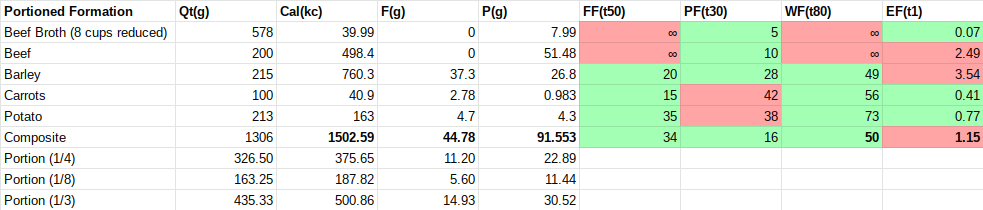
Second, a portioned list formation is a formation with a repeated set of components. The components are copied under the composite and the factor is applied to each component. This is useful in portioning for multiple people. The parts of a portioned list formation are:
- Header - designation (named or unnamed) and formation parameters
- Collection - a group of resources
- Composite - a row used for aggregating the collection and analysis
- Portion Row - a row that declares the portion amount
- Portioned Components - the components that have been multiplied by the portion amount

The Definition Structure
The definition is designed for nested resources and reuse. If you find yourself copying and pasting large numbers of the same resources, creating a definition makes sense to save space and effort. The parts of a definition are:
- Header - designation (named or unnamed) and definition parameters
- Collection - a group of resources
- Composite - a row used for aggregating the collection and analysis
- Seed - a row designed for copying and pasting into other structures

The Grid Structure
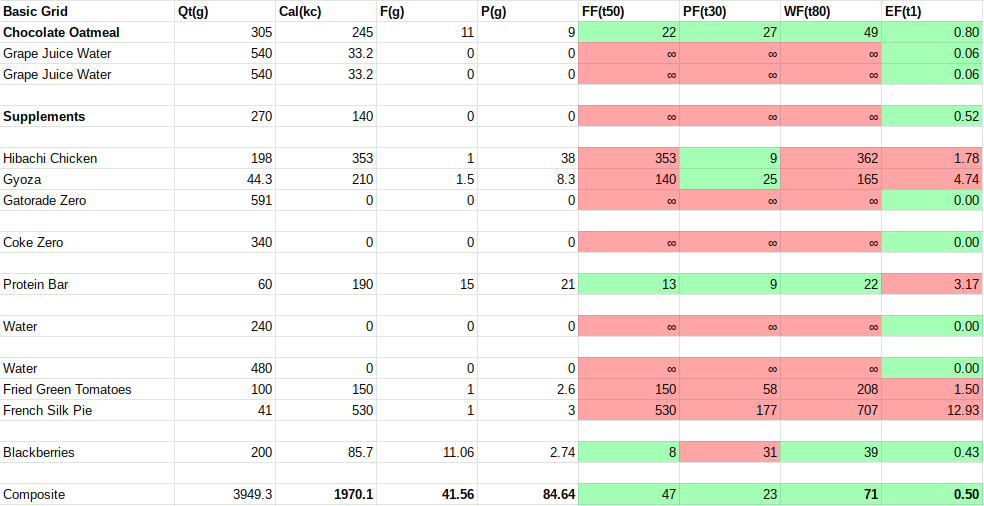
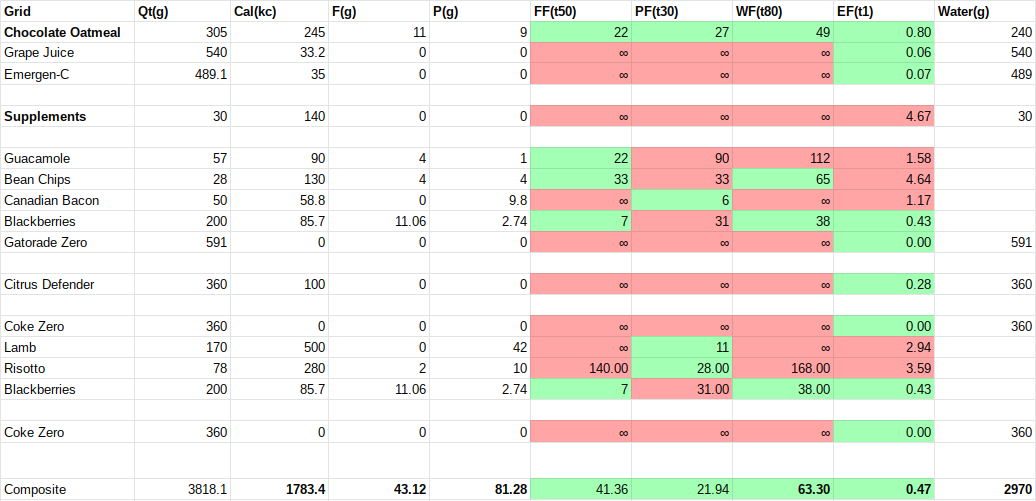
The grid is a structure designed for tracking daily resource consumption as a whole. Some people don’t eat 3 separate meals and instead eat small portions off and on all day. This is what the grid was designed for. It also simplifies the composite by aggregating the whole day into one global composite; formations, on the other hand, must be tallied in order to determine the global composite. Also, the grid has spaces between resources and resource groups signifying the passage of time. Therefore, it helps you analyze your eating habits by being organized chronologically. The parts of a grid are:
- Header - designation (named or unnamed) and grid parameters
- Collection - a group of resources, resource groups, and spaces (sorted chronologically)
- Composite - a row used for aggregating the collection and analysis
- Seed - a row designed for copying and pasting into other structures
This is what a grid looks like:
The Map Structure
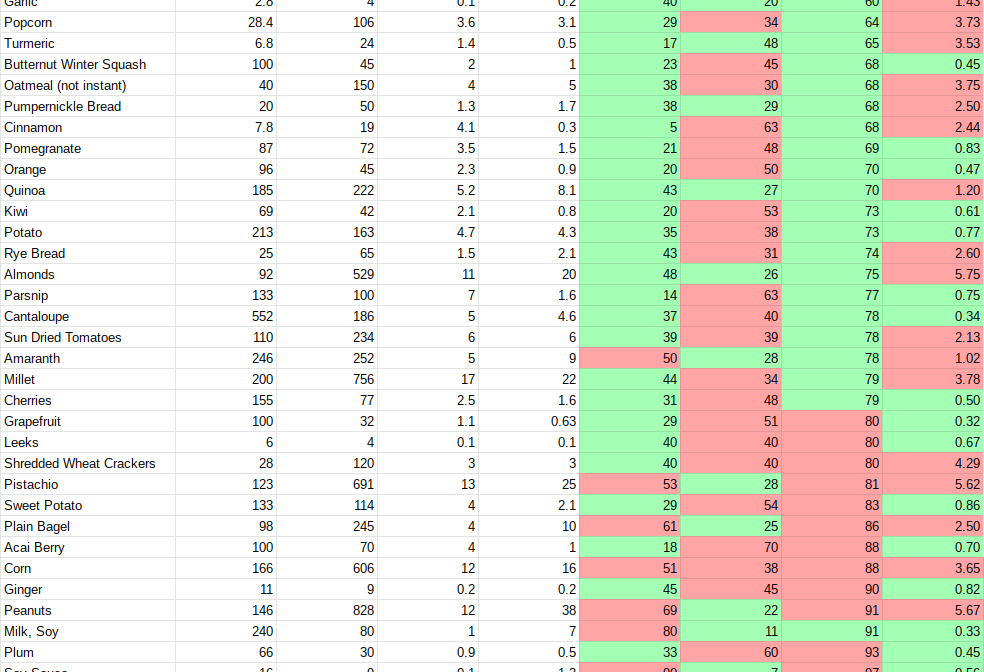
The map is the largest-scale structure, organized as a double list. The first is sorted by W and the second by E. The map is designed for reference. Resources that have nutritional value float to the top and those that don’t sink to the bottom. Those at the top are complete because they do not have division by zero. Those at the bottom are incomplete because they have natural division by zero (for example, meat). One list isn’t better than the other. We need complete resources for nutritional value, and we need incomplete resources for protein value and energy. The parts of a map are:
- Header - designation (named or unnamed) and map parameters
- Collection 1 - a group of resources organized by W
- Collection 2 - a group of resources organized by E
The resources map is designed to be read-only which means you can copy but you can’t modify. The personal resources map is designed to be modifiable.
This is what a map looks like:
The Designation of a Resource
The designation is more than just a name. It is a way of namespacing the resources of TWS. Two resources with the same designation would create a collision.
There are a few considerations before selecting a designation:
- Uniqueness
- Sensibility
- Specificity
1) Every designation should be unique. 2) Every designation should represent what it claims. In other words, it must be truthful or make sense in the context of the resource. 3) Lastly, it should be specific. For example, it is not possible to create a resource with the designation “fruit”. It is too generic. However, “canned peaches” is specific enough to be a designation.
When it comes to designation specificity, specific is almost always a better choice than generic. For example, if you create a resource for “tomato sauce”, which brand do you use? You can increase the specificity of the designation to “Classico tomato sauce”.
The designation is the left-most cell of a resource:

The Components of a Resource
The components of a resource are the key parameters of dietary information that give rise to the expression. The fundamental relationships between the components of a resource is a unique signature that defines that resource and it’s expression. There are 4 components:
- Quantity (Mass)
- Calories
- Fiber
- Protein
1) The quantity represents the mass of the resource. 2) The Calories represent the energy of the resource. 3) The fiber represents the fiber content of the resource. 4) And the protein represents the protein content.
The components are the 4 cells right of the designation:

These numbers show you the amounts in the context of a structure. For example, in a grid, the composite fiber shows you the total amount of fiber you ate during the day. Amounts are considered desirable or undesirable based on a range. This is a span between 2 numbers that the amount must fall within. If it doesn’t, the amount is either too low or too high. For example, my Calorie range is 1000-1500. Below 1000 is not enough energy, and above 1500 is too much energy. Hitting your ranges is always a balancing act.
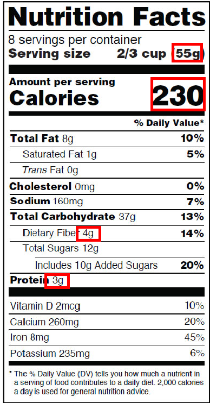
Components can be easily harvested from a nutrition label:
The Expression (Metrics) of a Resource
The expression and Metrics are at the heart of TWS. In fact, I created metrics first and then went back and uncovered the math behind it. The expression is the behavior of a resource. If the components are like the DNA of a resource, the expression is the physical manifestation. It is composed of 4 factors that are derived from formulas taken from the relationships between various components.
How do you determine the factors for a resource? You can use the following formulas to do so. In your system worksheet, make sure the expression is an actual formula instead of just a static number. Once you do this once, you should be able to reuse it for all other resources.
The Fiber Metric
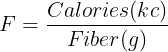
By dividing the number of Calories by the amount of fiber, you will obtain a number that will help determine the overall fiber value of the resource. You can use this number when trying to decide between closely related resources. This is used to maximize fiber and minimize Calories. For example:
The F for 1 Nutrition Bar is 220 Cal/14g Fiber: 220/14 = 15.7F
This bar would be considered an overall great source of fiber value; anything less than 50F is an overall good choice. We can also tell how this nutrition bar compares to other bars in the grocery store, so you can get the bar with the highest fiber value. If there are no Calories, the F bottoms out at zero, and if there is no fiber, it is undefined.
The Protein Metric
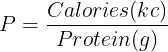
By dividing the number of Calories by the amount of protein, you will obtain a number that will help determine the overall protein value of the resource. You can use this number when trying to decide between closely related resources. This is used to maximize protein and minimize Calories. For example:
The P for 1 Nutrition Bar is 220 Cal/13g Protein: 220/13 = 16.9P
This bar would be considered an overall great source of protein value; anything less than 30P is an overall good choice. We can also tell how this nutrition bar compares to other bars in the grocery store, so you can get the bar with the highest protein value. If there are no Calories, P bottoms out at zero, and if there is no protein, it is undefined.
The Wholeness Metric

By aggregating the F and P, you will obtain a number that will help determine the overall wholeness and nutritional value of the resource. You can use this number when trying to decide between closely related resources. This can also be used to maximize overall value and minimize nutritional incompleteness. For example:
The W for 1 Nutrition Bar is: 15.7F + 16.9P = 32.6W
This bar would be considered an overall great source of wholeness; anything less than 80W is an overall good choice. We can also tell how this nutrition bar compares to other bars in the grocery store, so you can get the bar with the highest overall nutritional wholeness. If either F or P are undefined, the W is also undefined.
The Energy Metric
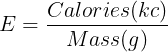
By dividing the number of Calories by the amount of mass or quantity, you will obtain a number that will help determine the overall energy density of the resource. You can use this number when trying to decide between closely related resources. This is used to minimize high-Calorie foods or balance them out by pairing them with low-Calorie foods. For example:
The E for 1 Nutrition Bar is 100 Cal/25g: 100/25 = 4E
This bar would be considered too energetic to be eaten by itself; anything less than 1E is an overall good choice. We can also tell how this nutrition bar compares to other bars in the grocery store, so you can get the bar with the lowest energy density. If there are no Calories, the E bottoms out at zero, and if there is no quantity, it is undefined.
There are five main considerations to E, namely protein, sugar, oil, alcohol, and mass. These variables give you a formula for a quick estimation of E.


The way to read and understand this expression is as follows:
E = energy value, p = protein, s = sugar, o = oils, a = alcohol, m = mass
When E is low, p, s, f, and a also tend to be low, except for m which tends to be high. On the other hand, when E is high, p, s, f, and a tend to be high, except for m which tends to be low. That means that people who have high energy value eat small amounts of protein, sugar, fat, alcohol, and large amounts of mass like water. Similarly, people who have a low energy value eat large amounts of protein, sugar, fat, alcohol, and small amounts of mass like water.
You can see all 4 metrics in the figure below. A metric is either green or red depending on whether it meets the defined threshold. Metrics use thresholds instead of ranges. TWS thresholds are all inversely proportional. This means that lower numbers have higher values. You can see below that the first 3 metrics are below threshold and the last is not:

The Metrics Become The Wellness Formula
Using the four metrics above, we can blend them together into a system of literal equations. This system of equations is called The Wellness Formula and is at the fundamental core of each resource. Each resource has 4 components which are just inputs fed into the system. But once that happens, the system comes alive. Mathematically, the system emerges from the metrics:
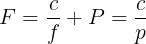
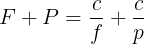
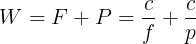
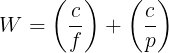
In the first line, we see the basic relationships between the amounts of fiber, protein, and Calories. Then we add both of those equations together to understand the relationship between the first two metrics. The third equation defines W as a higher order metric, or rather a metric made of metrics. To simplify all this information, it is written in a straight-forward, user-friendly form.
The second equation in the formula, which is also the fourth metric, is already in simplest form:

Then we can group these simple equations together as a system:
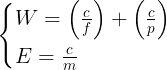
This formula defines the operations that are performed on the components of each resource and is therefore responsible for the values of each metric. W tells us about the nutritional information of the resource, and E tells us about the leanness and energy density. Each equation operates independently from one another but says something unique about the resource in question.
Let’s do a very simple example of using The Wellness Formula:
Using the components f, p, and c, fill in the variables and solve for W:
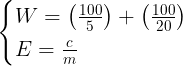
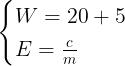

Using the remainder of the components (m), solve for E:


Now we have a solution to each equation in the Wellness formula. Even though this resource doesn’t exist, we can still infer information about it for example, this imaginary resource is complete (has a solution for both sub-equations), it is very high in nutrition, and has an elevated E which indicates the presence energy. Since this doesn’t normally happen for a singular resource in nature, we can conclude that this must be a sandwich or a salad.
The Threshold Formula
Part of the basics of The Wellness System is the usage of thresholds and non-linear functions. It uses thresholds as a means of expressing desirable or undesirable behavior. One metric that is above a threshold is not a problem, however when every resource in your formation is red, that’s a clear indicator that you need to rethink your meal.
When working in your worksheet, it can be overwhelming with all the numbers flying around. So, I created the threshold formula to help you visualize the properties and the metrics of a resource. The Threshold formula is an auxiliary system of equations, part of The Wellness System, designed to help you make sense of all the data you are working with.
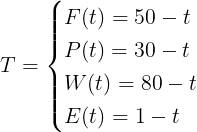
In each equation, the variable t represents a corresponding metric’s value. Also, every initial number is the threshold for that particular metric. Here is an example of reducing the threshold formula:
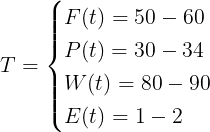
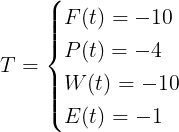
As you can see, this resource is undesirable. It is over threshold in every single metric, even though not by much. However, mixing it with a more desirable resource could make it more desirable.
Lets try out using the Wellness formula and the threshold formula with, say, bean sprouts:
First we solve for W by using the information on the nutrition label (c, f, p):
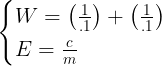

Next E. We solve for E by using the nutrition label as well (c, m):

Now we determine the threshold factors:
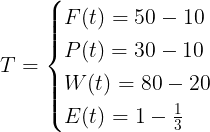
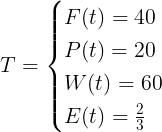
Initially, W and E have to be solved before we can begin to make inferences about the sprouts. After W and E are solved, we can begin to determine the threshold factors. First, we plugin the values for each t according to each threshold. Second, we solve for each equation and determine the threshold factor for each metric. This gives us a lot of detail about each metric instantly, i.e. all the metrics are under threshold (all positive), W has the highest score, this resource has twice as much fiber value as protein value, etc.
Comparative Analysis
You don’t have to apply both equations or use the threshold formula in order to make inferences about the component information. For example, you can use W to compare canned goods at the grocery store. Or you can use E to uncover which meat is leaner. But for example, we are going to perform a complete comparative analysis on these two protein shakes.
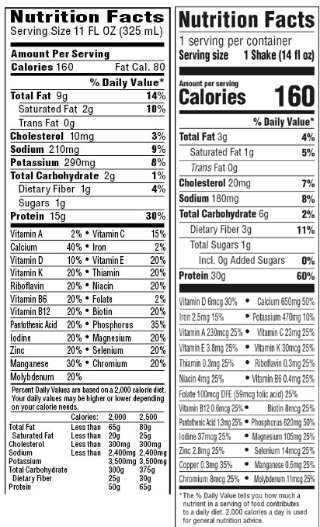
Evaluate the nutrition label on the left:
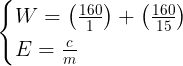
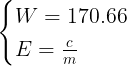
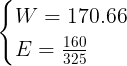
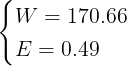
Evaluate the nutrition label on the right:
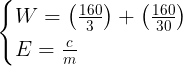
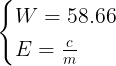
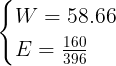
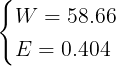
Now we can compare and analyze. I added the threshold formulas as well:
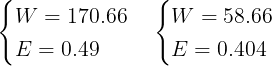
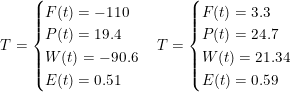
Now, this starts out a little deceptive. For any calorie counter, they would look at both and see that they both have the same number of calories. So they might think it’s a toss up and choose the one that looks more enticing. But there is useful information hidden in the label that TWS will bring out.
Looking at the Wellness formulas, the left has a high W which indicates very low nutritional value. The E is about average. The right has a lower W which indicates a higher nutritional value, and E is .4 which is about normal. Just by looking at the Wellness formulas, we can tell which is a better choice; the right one.
Just for fun, lets add the threshold formulas into the mix. Looking at the left thresholds, we can now see why the W is so high. The fiber value is 110 above threshold which pushes the W up to 90.6 above threshold. The protein value is not impressive, it’s close to threshold, and the E is normal.
When comparing resources, the difference between the two values for W will give you a gap between the value and the threshold. This is what the threshold formula measures. Secondly, the difference between the two values for E will give you a gap between the values and the threshold. You can then make an inference based on the two values.

Sometimes a component can be zero causing W to be infinite. For example, fiber is zero for meat resources. When fiber or protein is zero, the corresponding F or P is infinite. We can show that this is the case by decreasing the amount further and further towards zero and the result is a metric that grows higher and higher. So the actual metric for a zero fiber or protein amount is infinity.
This presents a challenge with W since it is the sum of F and P. If F or P is infinite, W is also infinite. For infinity plus a normal integer is infinity. Resources that have an infinite W are called incomplete and are usually sorted by the E instead of the W. This is why a map structure has two lists, one for complete resources (W is finite) and the other for incomplete resources (W is infinite).
You can still use incomplete resources for the value they contain. For example, meats are incomplete however they usually have some of the highest protein value of any resources. You don’t have to worry about division by zero in the components. A component that is zero will simply aggregate to zero.
If the number of Calories is zero and the fiber, protein, and mass are non-zero, the expression is all zeros. This rarely happens since the presence of protein has Calories. More common is when the mass is non-zero and Calories, fiber, and protein are all zero. This creates infinity in F, P, and W and zero in the E. This is the signature of water.
Here is a resource that has zero fiber and therefore an infinite F and W:

Notice how this resource still has useful information even though W is infinite; we know that E is .54 which is below threshold and that P is 5 which is way below threshold. So, even though egg whites have an infinite W, they are a fantastic choice for protein value and energy value.
Importing and Integrating a Resource
If the resource you want to use isn’t in the resource map, you can import it into your personal resource map. The importation process is as follows:
- Create a designation
- Harvest the components from a nutrition label or database (integration)
- Use the formula to populate the expression
- Make sure the resource is sorted properly
And that’s it. It’s very simple. Use the resources integration tab to help you convert units into grams if they aren’t already in grams. Calories is the only component that isn’t represented in grams.
How do you sort the updated map?
In Google Sheets:
- Highlight the resources you want to sort, including the header
- Click Data > Sort Range
- Select the column to sort by either as a letter or as a header column name
- Select the direction to sort
- Click Sort
In Excel:
- Highlight the resources you want to sort, including the header
- Select Data > Sort
- Select Sort By and choose your column for sorting
Resource Extensions
You can create extensions for resources by adding columns to the right of the resources. For example, you could create a column called “Caffeine”. This would be used to measure the caffeine amounts for a list. The list could then be sorted by the new column as a caffeine study.
You can apply any extension you want as long as you are able to harvest the necessary information. One of the simplest extensions is water. All you do is log the obvious amount of water in a resource. You don’t have to be extremely precise. For example, if you have 20 resources and they are all vegetables, it would take forever to obtain the water content for each. So instead, just log those things that are “aqueous” (things that are made of almost all water).
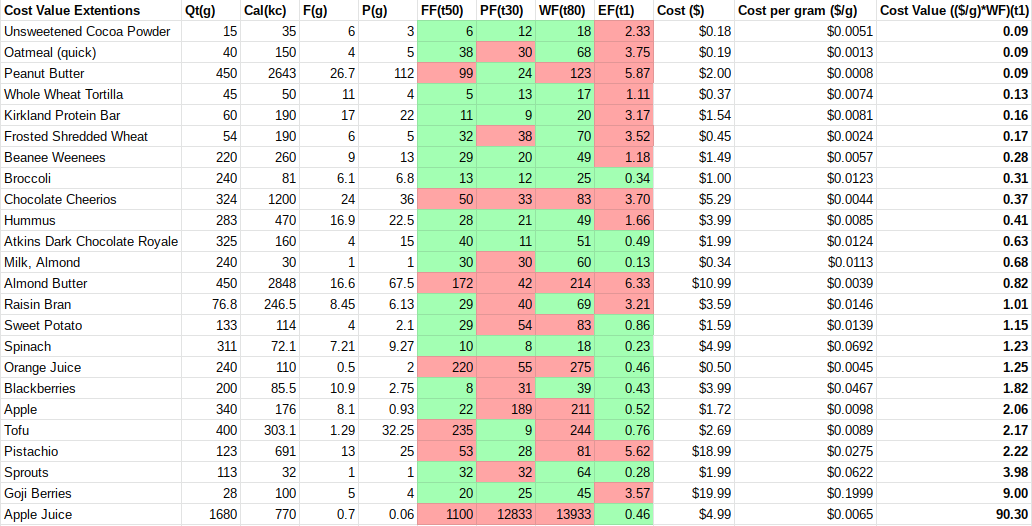
This is an example of a more complex extension that explores the relationship between a resource’s W and its cost. It’s called cost value. A high cost value is undesirable and a low cost value is desirable:
The Header of a List
The header of a list has 2 parts:
- Designation
- Units
The designation can be either generic or specific. A generic designation is simply called “List”. A specific designation describes the contents of the list like “Milk Study”.
The 8 units are the same for all structures. An extension adds an additional unit(s). The header row is the top row of any structure. This is a list header with a specific designation:

The Collection of a List
The collection of a list is a group of resources that belong to the list. There are 2 types of collections:
- Unsorted
- Sorted
Unsorted collections have no particular order. Sorted collections are sorted according to a property of the collection, like header units or chronology.
Collections are usually the same for higher structures except the grid. A grid has spaces between the collections forming resource groups. Each resource group is a collection.
The graphic below shows an unsorted list collection surrounded in red:

The Sort of a List
The sort of a list is its organization created by ordering the collection according to a parameter, such as chronology or one of the header units. Sorting according to W reveals the nutritional value of the collection, highest to lowest. Sorting according to designation shows a simple alphabetical collection.
Any structure with a collection can be sorted. Grids are usually sorted chronologically, but they could be sorted by a header unit.
Below is a graphic of a generic list sorted by Calories, low to high:

Lists do not need to be sorted, but most of the time a sort will reveal some mathematical or physical truth about the collection.
The Header of a Formation
The header of a formation has 2 parts:
- Designation
- Units
The designation can be either generic or specific. A generic designation is simply called "Formation". A specific designation describes the contents of the formation like “Milk Study”.
The 8 units are the same for all structures. An extension adds an additional unit(s). The header row is the top row of any structure. This is a formation header with a generic designation:

The Collection of a Formation
The collection of a formation is a group of resources that belong to the formation. There are 2 types of collections:
- Unsorted
- Sorted
Unsorted collections have no particular order. Sorted collections are sorted according to a property of the collection, like header units or chronology. Formations are generally not sorted.
The graphic below shows an unsorted formation collection surrounded in red. Note that the composite is not part of the collection:

The Composite of a Formation
The composite is of highest importance. It aggregates the collection(s) which gives rise to a global expression revealing the nature of the structure. For example, if a composite is all red, the entire structure can be considered out of balance. If that is the case, it signifies that resources need to be added, subtracted, or reportioned in order to balance the structure.
A composite is the aggregate of the components and the corresponding expression made from that aggregate. Notice that the global expression is not an aggregate of the above expressions. Expressions are always derived from a set of components.
The example below points out the composite. The composite is at the bottom of a structure except for a definition where the seed is at the bottom:

The Header of a Definition
The header of a definition has 2 parts:
- Designation
- Units
The designation of a definition is always generic because the seed carries the specific designation.
The 8 units are the same for all structures. An extension adds an additional unit(s). The header row is the top row of any structure. This is a definition header:

The Collection of a Definition
The collection of a definition is a group of resources that belong to the definition. There are 2 types of collections:
- Unsorted
- Sorted
Collections are usually the same for higher structures except the grid. A grid has spaces between the collections forming resource groups. Each resource group is a collection.
The graphic below shows an unsorted definition collection surrounded in red. Note that the composite and the seed are not part of the collection:

The Composite of a Definition
The composite is of highest importance. It aggregates the collection which gives rise to a global expression revealing the nature of the structure. For example, if a composite is all red, the entire structure can be considered out of balance. If that is the case, it signifies that resources need to be added, subtracted, or reportioned in order to balance the structure.
A composite is the aggregate of the components and the corresponding expression made from that aggregate. Notice that the global expression is not an aggregate of the above expressions. Expressions are always derived from a set of components.
The example below shows the composite for a definition. The composite is at the bottom of a structure except for a definition, seen below, where the seed is at the bottom:

The Seed of a Definition
The seed is unique to the definition. Once the composite is determined, it is copied into the row beneath it, given a specific designation, and converted into static numbers. The seed is the resource that will be copied and pasted into other structures and will represent the definition from which it comes. This is similar to a seed falling from a tree.
The designation text of the seed is always bold so you will always be able to recognize whether a resource is nested or flat. If you need to update the definition, you should update the seed as well. This will cause a deprecation of the seed (having old information). To fight deprecation, only select the seed directly from the definition tab and not from another structure.
This is a seed row from a definition:

The Header of a Grid
The header of a grid has 2 parts:
- Header
- Units
The designation can be either generic or specific. A generic designation is simply called “Grid”. A specific designation describes the contents of the grid or the grid itself like “Grid 12/13/18”. Grids are almost always generic.
The 8 units are the same for all structures. An extension adds an additional unit(s). The header row is the top row of any structure. This is a grid header with a generic designation:
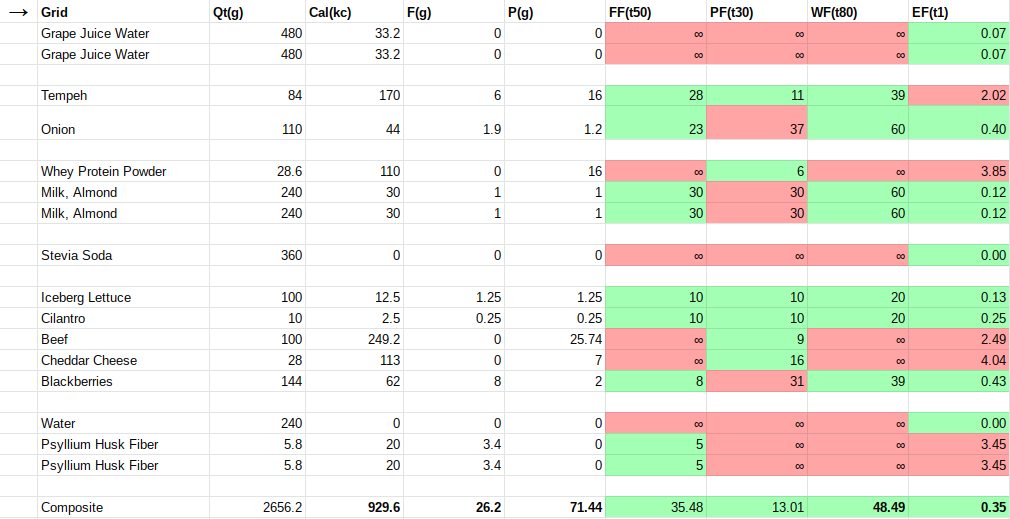
The Collection of a Grid
The grid is a single or group of collections that belong to the grid. There are 2 types of collections:
- Unsorted
- Sorted
Unsorted grid collections have no particular order. Grids can be sorted according to a header unit, however grids are usually sorted chronologically.
Collections are the same for all higher structures except the grid. A grid has spaces between the resource groups forming a complex collection. A lone resource is consumed by itself, a resource group (adjacent resources) is consumed together, and a space represents a period in time between resources or resource groups. This helps you to understand the periodicity of your eating habits, not just the resources.
The graphic below shows a chronological complex collection surrounded in red. Note that the composite is not part of the complex collection:
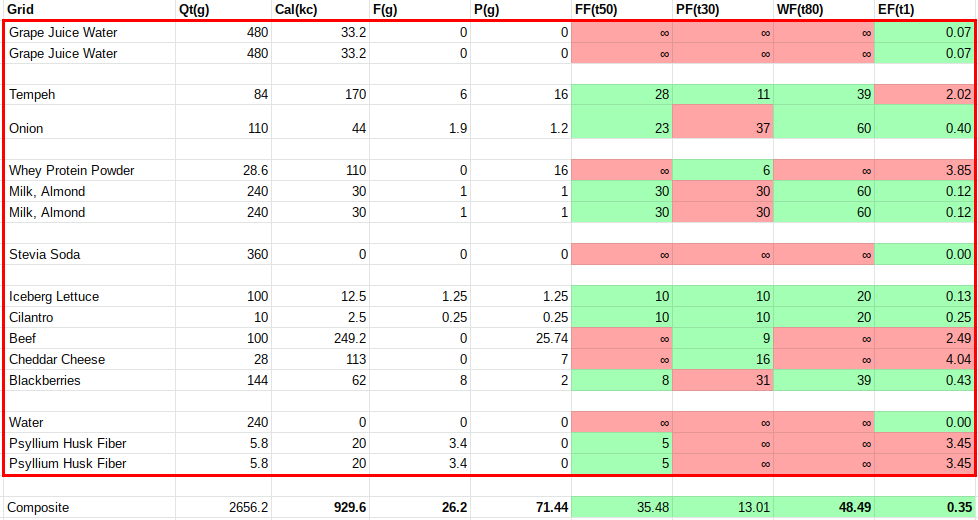
Next, the following graphic shows a lone resource as part of a complex collection:
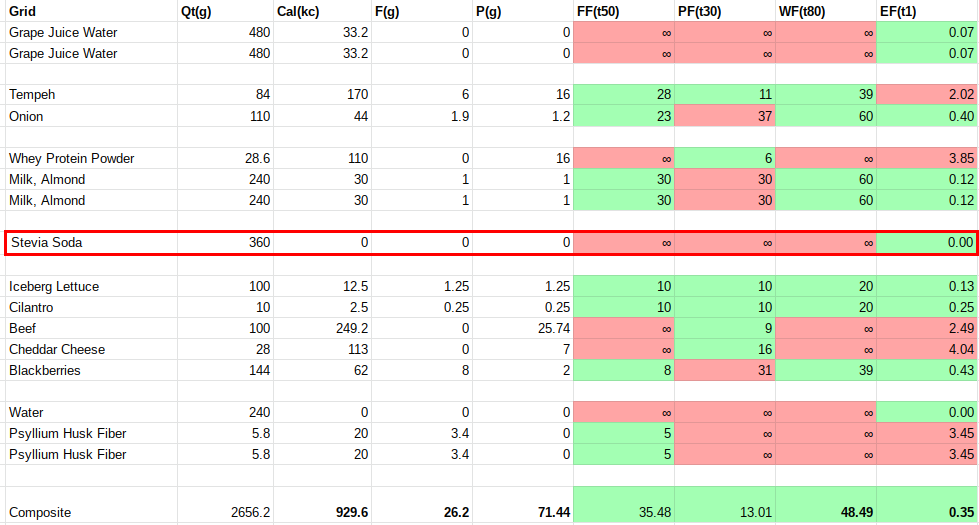
Next, the following graphic shows a resource group as part of a complex collection:
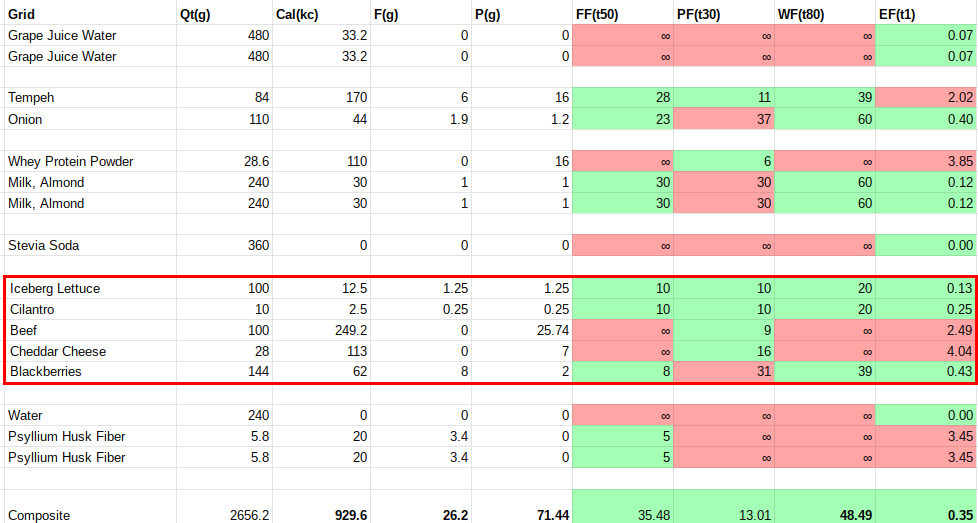
Lastly, the following graphic shows a space which indicates a period of time as part of a complex collection:
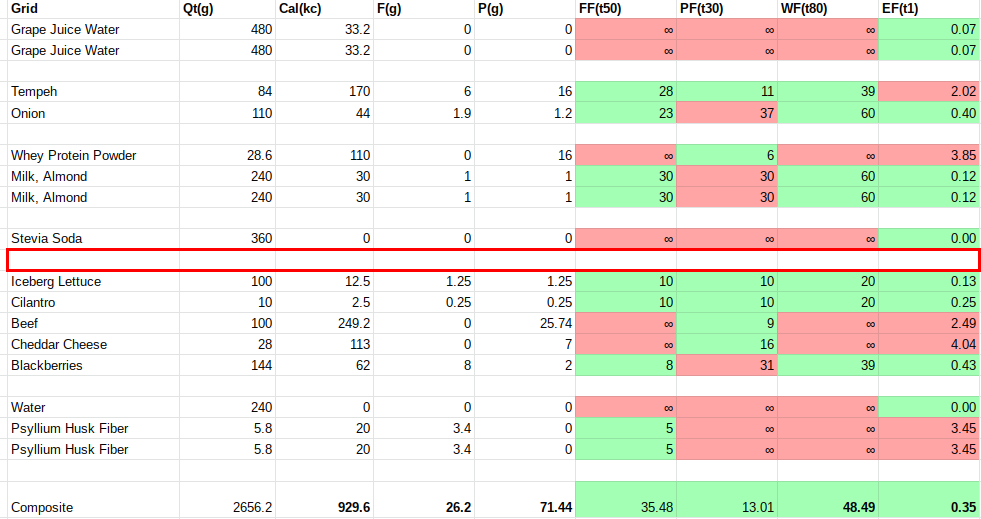
The Composite of a Grid
The composite is the most important part of the structures that have them. It aggregates the collection which gives rise to a global expression telling you about the nature of the structure. For example, if a composite is all red, the entire structure can be considered out of balance. If that is the case, it signifies that resources need to be added, subtracted, or reportioned in order to balance the composite.
A composite is the aggregate of the components and the corresponding expression made from that aggregate. Notice that the global expression is not an aggregate of the above expressions. Expressions are always derived from a set of components.
The example below shows the composite. The composite is at the bottom of a structure except for a definition where the seed is at the bottom:
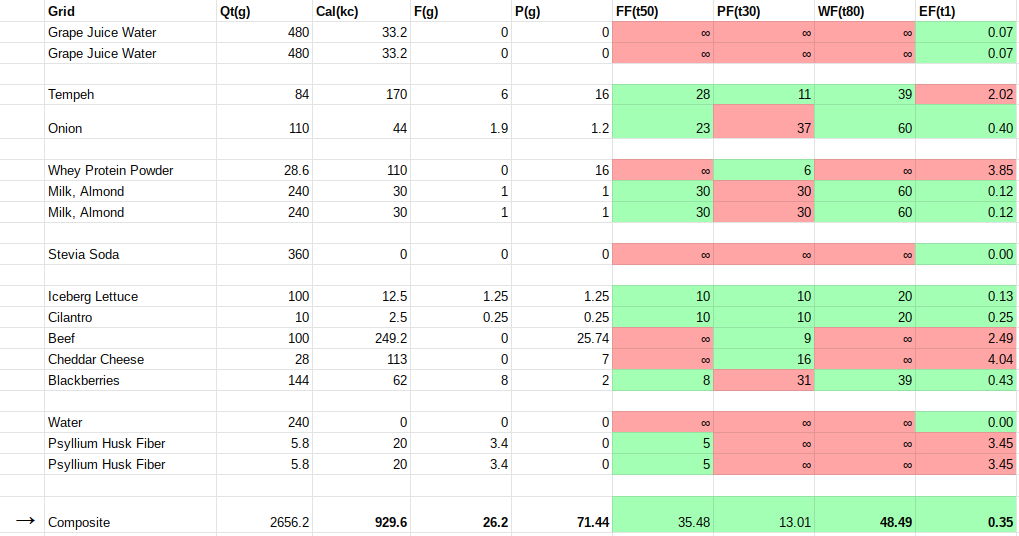
The Header of a Map
The header of a map has 2 parts:
- Designation
- Units
The designation is always generic, written as “Designation”.
The 8 units are the same for all structures. However, a map contains more detail in the header than other structures. For example, the units are labeled, the mathematical units are listed (Cal/g), the sorting is listed, and there is a key to define the coloration. Also, the header rows are frozen so as you scroll, you can refer to the header to aid understanding of the map.
Here is the header from a map:
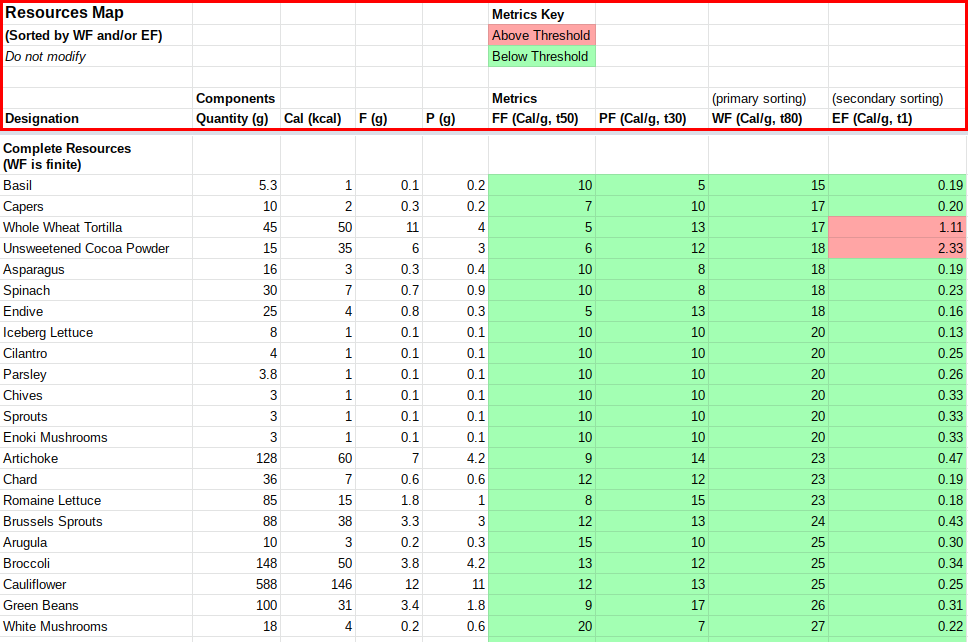
The Collections of a Map
A map has 2 collections, both of which are always sorted in a specific way. A map is a double list; the first list is for complete resources (those that have a well-defined W) and the second list is for incomplete resources (those that have an infinite W). Instead of being sorted by the W, the incompletes are sorted by E.
Since W is an estimation of nutritional value, those resources with greater nutritional value tend to float to the top of the first list. Those without it sink to the bottom.
Since incomplete resources have no W, they are sorted according to their energy value (E). Energy value can be thought of as a measure of “energy sparsity” or “energy density”. The resources at the top tend to be energy sparse and those at the bottom tend to be energy dense.
Incomplete resources should not be considered as inferior to complete resources. They simply have a different behavior. The W of an incomplete resource is infinite. This doesn’t mean that the resource has no or bad nutrition; it simply means the nutritional profile is incomplete. In other words, incompleteness means a resource is missing fiber, protein, or both.
For example, meats are missing fiber. This seems to be something that nature simply does. Even though meats are incomplete, they still have value, particularly protein value. Mixing them with nutrions is a great way to get both fiber and protein.
The graphic below shows a map’s primary collection surrounded in red:
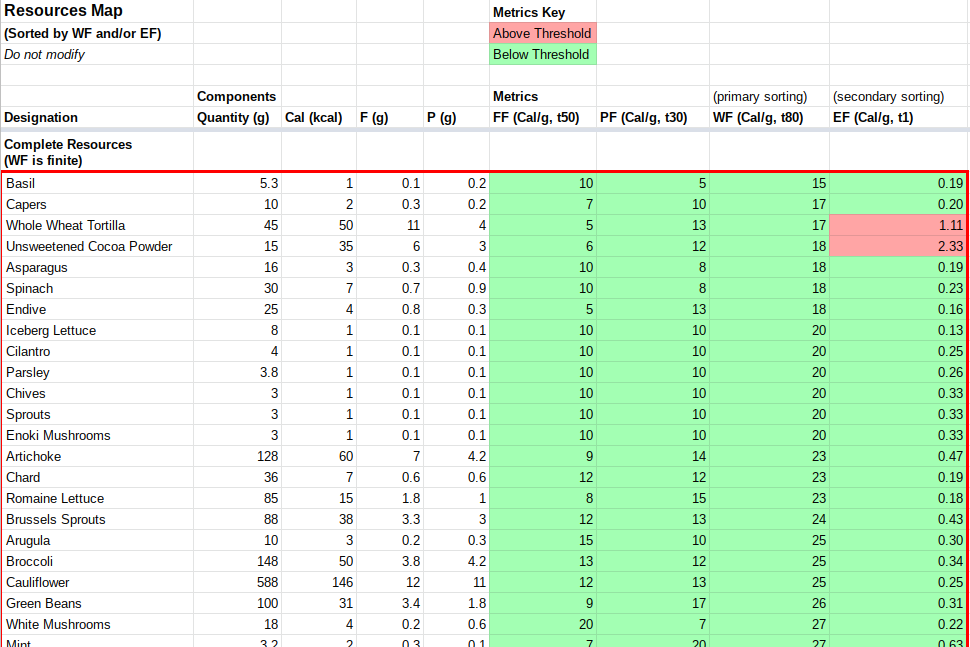
The graphic below shows a map’s primary and secondary collections, both surrounded in red:
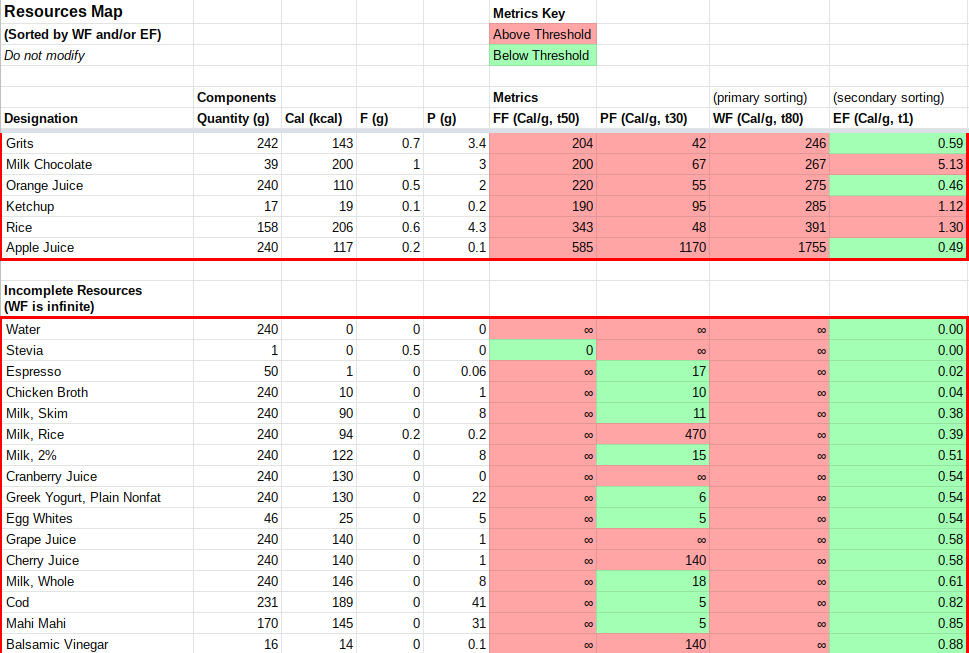
Reinforcers
A reinforcer is a special kind of resource. TWS encourages that you consume a wide variety of resources and avoid resource repetition. However, reinforcers are used to supplement your meals and can be consumed as often as you like.
For example, nature’s most perfect food for fiber is the blackberry. If you are consuming a meal and you notice it’s low in fiber, just throw in some blackberries (usually about 200g) and watch the W go down. Another reinforcer, this one used for protein, is Canadian bacon. Consuming a meal of Canadian bacon and blackberries is fantastic!
Here is a graphic with reinforcers that I have discovered. There could be more of them out there waiting for you to discover:

Tuning
Tuning is the process of raising or lowering the components of a resource. This determines the magnitude of the corresponding composite expression. For example, if you have a hot dog for dinner, 30g of spinach isn’t going to do much to balance it out:
This is where tuning comes into play. We can increase the magnitude of the spinach by tuning it up. If we tune it by 10, it balances out the composite and gives this meal value:

This is a very important part of TWS. You can consume resources that have low value as long as you balance them out with resources that have higher value.
Lets say you are craving a hot dog. If you eat a hot dog by itself, it has low value and you leave it unbalanced. However, if you balance it out with spinach, it makes consuming the hot dog ok. As long as you are balancing your composites, you are creating value in your body.
This doesn’t mean you can binge on junk food. That would have low value. But you can eat some chips with the proper amount of salad. This gives you the freedom to eat what you want, as long as you keep balancing your composites. Let the math work for you. Just follow the system and you won’t be misled.
How do I tune a resource?
Tuning a resource is relatively simple. There are 2 steps:
- Determine the tuning factor
- Multiply all the components by the tuning factor
Determining the tuning factor is usually done by estimating the quantity you want to consume. However, you could do it for any of the components.
Once you determine how much you want to tune up or down, multiply every component by the tuning factor. Notice that once you do this, the expression stays the same. This is because the expression is qualitative and will always be the same since the relationships between the components remain the same.
Cloning
Cloning is a method for simplifying portion and quantity management. Instead of doing the math for the tuning process, cloning is a way of bypassing the math.
The cloning method has 1 requirement: tune the resource down to a small number. Once you do this, you can copy and paste the same resource as many times as you want. This is very useful for resources that are separated into discrete pieces, for example, chicken fingers or wings:
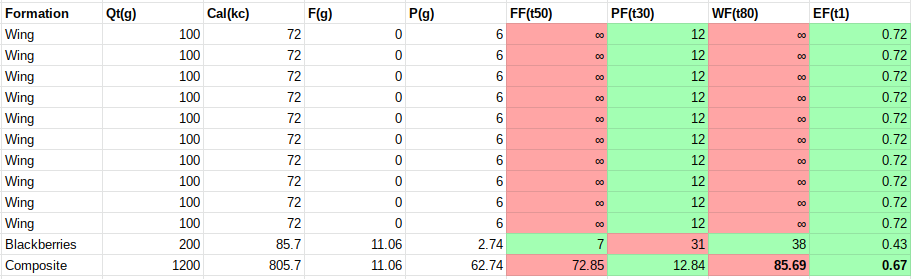
Portioning
Portioning is the key to weight loss. Even if you consume resources with high nutritional value, you won’t lose weight unless you maintain a Calorie deficit.
How you portion your resources determines the pace at which you gain or lose weight. And knowing your BMR (basal metabolic rate) determines how you portion your resources.
How do you obtain this number? There are a few websites out there that will estimate your BMR based on parameters like height and weight. However, I recommend obtaining a fitness tracker like fitbit. This will give you a more accurate BMR. I know these are a little expensive, but consider this an investment in your health.
Once you’ve attained your BMR, you are ready to start thinking about planning your portions. Create a range with 2 Calorie intakes, one low and one high. Each Calorie intake will create a deficit when subtracted from your BMR. If your target is the low number, you will lose weight faster. If your target is the high number, you will lose weight slower. You can determine your speed by multiplying your deficit by 7 and dividing by 3500. This tells you how many pounds you lose per week.
You can enter all of this information directly into the header of the whiteboard in the system worksheet. This will help to balance your numbers and meet your goals.
Resource Variety
Any nutritionist will tell you that it’s good to eat a wide variety of fresh resources. TWS agrees. Consuming a variety of resources ensures that you are getting all of the vitamins and minerals your body needs. There are two things that aid in the uptake of nutrition:
- Plan your meals ahead
- Eat fiber-rich foods
Planning your meals ahead of time makes it easier to avoid resource repetition. For example, if you notice that you have egg whites for breakfast one day and egg whites for breakfast the following day, if you plan ahead, you can change it to something similar like Greek yogurt without repeating.
Why fiber-rich foods? Not only do they provide fiber, but the presence of fiber is indicative of vitamins and minerals. So, you don’t need to measure the dozens and dozens of nutrients in a resource. If a resource has fiber, it probably also has nutrition.
As mentioned already, there is one exception to the avoid repetition guideline: reinforcers. Reinforcers are the super foods of TWS. You can consume reinforcers as much as you like. Just remember that a little bit goes a long way.
Fasting
Fasting can be a useful tool in your TWS tool belt. It can free up some Calories allowing you to eat more for other meals. It also teaches your body to be more efficient, causing you to eat more efficiently during other meals. In fact, I discovered that by fasting for breakfast (I still have watered-down grape juice, about 60 Cal) my body tends to crave less for lunch and dinner.
If you know that you are going to be eating out for dinner or eating large portions, there’s nothing wrong with fasting to counteract the large portions. For example, have juice for breakfast and 2 slices of Canadian bacon for lunch. This is called micro-fasting, fasting except for a tiny amount of resources.
Just make sure that you aren’t fasting too much. Too much can be dangerous. After fasting for 3 days, your body begins to lower your metabolism which prevents you from losing weight. I’ve noticed that my body responds better when I consume at least 1000 Cal a day. I’ve also noticed that smaller portions for dinner seems to work better for my body. I used to fast almost all day until dinner and eat as much as I wanted. Over time, I noticed I wasn’t losing any weight. That’s when I realized that overeating is a problem regardless of your fasting or Calorie deficit.
Overall, fasting is useful in small doses. Practice micro-fasting to help you lose weight.
Momentum
Momentum is the concept that every person is moving either towards or away from reaching a state of wellness in their body. Someone who eats fast food every day likely has negative momentum, moving away from wellness. Someone who eats a variety of fresh veggies, fruits, meats, and whole grains is likely moving towards wellness. Your momentum tells you how quickly you are approaching or moving away from wellness.
It is the goal of The Wellness System to give you the tools you need in order to move towards wellness. Wellness is attainable for everyone, it just takes a little time and work.
Momentum can be quantified by a few factors:
- Variety
- Portions
- Long-term application
Variety keeps your body guessing as to what it will get next. If you don’t allow it, your body will never get used to common resources. Low portions tend to help your body to be more efficient which leads to wellness.
The long-term application of variety and portions leads to wellness. For example, if you switch from a fast food diet and notice that after a week you don’t feel as good as you had hoped, remember that long-term changes are more effective than short-term. For example, if you already practice TWS, having a burger once in a while is not going to adversely affect your body.
Division by Zero and Infinity
Because the formulas for metrics contain variables in the denominator of a division problem, there are certain situations where division-by-zero creates a value of infinity. This happens particularly in meats that lack fiber, like lamb:
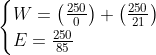
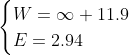

Anytime there is a zero component in f or p, their metric will be infinite. When fiber is zero, F will be infinity, when protein is zero, P will be infinity. Because the W is the sum of F and P, when either one of these variables is zero, the W too is also infinity.
The only exception to this is the E. When E is zero, none of the other components can be anything but zero because there is no quantity.
Just because a resource has infinity for one of its metrics doesn’t mean that its inferior or bad. All it means is that there is division by zero and can’t be measured. For example, many resources that lack fiber have a high protein value. You can easily overcome a division-by-zero by pairing the resource with a complementary resource that adds the missing component.
Expression Types
The expression is arguably the most important part of a resource. It tells you how a resource behaves. An expression can fit into 8 different types, each that describes a behavior:

As you can see, every type has a purpose, even the ones above threshold. This information is useful when balancing composites. For example, a nutrion wants energy and gives nutrition and mass. An energizer wants nutrition and mass and gives energy. Pairing these 2 resource types creates an attraction that holds them together.
Some people might say, then why don’t you just eat nothing but the green ones? This leads to a problem. For example, if you decide to get all of your 2000 Calories from spinach, you will find that you have to eat 8571g of spinach. This is, of course, not possible. So, it simply doesn’t make sense to eat nothing but nutrions and supernutrions, because they need energy.
There are resources that can be consumed alone, namely the energized supernutrion and the energized nutrion. They are energized because they have naturally more Calories than the other nutrions. Even though you could eat nothing but energized supernutrions and energized nutrions, it’s still important to eat a variety of resources. The best solution is to simply mix expression types with opposing types. Therefore, you get your nutrition from one source, your energy from another, and your mass from water.
Balacing Composites
The balancing process is at the heart of TWS. It’s how you know how much to eat of the foods you have selected. Most of the time, it will take you a couple of tries before you are able to balance the composite. TWS states that everything you eat must be a part of a structure that has a balanced composite. This ensures that you are getting exactly what you need. I’ll create an example meal using a formation.
First, come up with an idea, either on your own or use the resources map. Put your ideas into a formation:

Take a look at the expression which shows the behavior of the resources. Notice that the F is too high, pushing the W up. Now, we have two options, and you can decide which you will take. First, you can increase the amount of zucchini by tuning it up. Or, you can decrease the number of Calories by reducing the amount of cottage cheese, tuning it down. Let’s decide to decrease the amount of cottage cheese:

Now we have a balanced composite (balanced means all green). As you balance more and more structures, you will get better and better at the process. For example, it’s usually better to scale down than up (it helps you to consume smaller portions).
Impact
A resource’s impact is how it effects a composite’s W. The sign of the impact is determined by the difference between the composite’s W and the resources W. For example, if a resource’s W is 10 and the composite’s W is 100, the resource will have a positive impact on the composite. The magnitude of the impact depends on the difference between the composite W before and after aggregating the resource.
When balancing your composites, it is important to manage the impact that resources will contribute to the composite. For example, if you have a choice between three different flavors of the same product, and they have slightly different components, you can determine the impact that each resource has on the composite and choose the one with the highest positive impact. You can include resources that have a negative impact as long as you balance them out with another resource(s) with a positive impact.
The Milk Study
The milk study is a classic example of what I call “comparative analysis”. You compare a series of resources by sorting them according to a parameter. Comparative analysis usually reveals something interesting about the resources that make it up.
For example, the milk study reveals something interesting about milk:
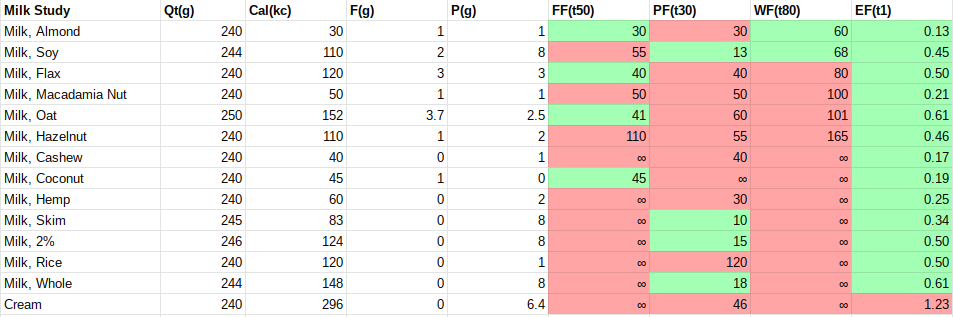
As you can see, most types of milk have little value. The 2 that do have value are almond milk and soy milk. Which one you choose depends on your strategy. If you want to lose weight, choose almond milk (fewer Calories). If you want to maximize nutrition, choose soy milk (more nutrition). According to TWS comparative analysis, almond milk has more value than any other milk.
The Natural Sweetness Study
This study helps you decide how to sweeten. Unfortunately, there really isn’t a good choice when it comes to natural sweeteners. Sugar seems to be sugar in whatever form it takes:

Honey is the only complete sweetener but has almost no value. Stevia has fiber value and energy value but is incomplete. If I had to pick a natural sweetener, I would choose stevia first because it has fiber value, then honey.
The Alcohol Study
The alcohol study compares different alcoholic beverages. It reveals that in general, alcoholic drinks have little value. Also, according to the E, beer is better than wine, wine is better than hard liquor, and hard liquor is better than liqueur:
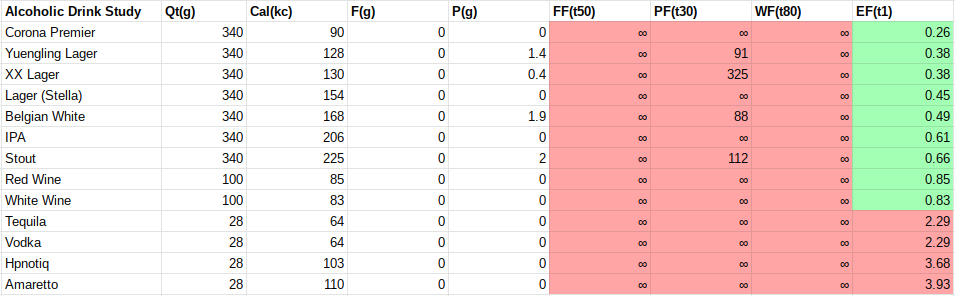
If you have to drink something with low energy density, low-Calorie beer would be the best choice. If you want to avoid something, cut out liqueurs. 1 ounce of amaretto has 110 Calories!
The Relativity of Impact Proof
This proof came to being when I was trying to establish whether or not certain foods were “healthy”. I avoid using the word “healthy” in TWS and I’m about to show you why. The problem comes when we try to say that some foods are universally “healthy”.
The relativity of impact proof shows that the impact a resource has on another resource (or resource group) is relative to the structure. This means that sometimes a resource is “healthy” and sometimes a resource is not “healthy”: it depends on the structure. Here is an example:
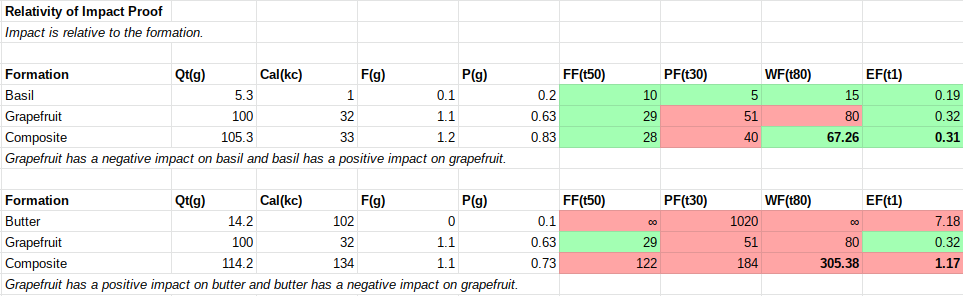
In the first formation, grapefruit has a negative impact on basil which means its “unhealthy”. In the second formation, grapefruit has a positive impact on butter which means its “healthy”. This means that grapefruit can be either “healthy” or “unhealthy” depending on the structure its a part of.
This shows that we can’t rely on impact as a measure of “healthfulness”. The value of a resource as shown in its expression is a better measure of “healthiness”. In fact, we can create a definition for “healthy”:
A healthy resource or composite is one that has a W below 80 and an E below 1.
There are exceptions to this rule depending on your food strategy. For example, many people choose to follow a Keto diet. This diet is based on restricting carbs and eating high protein/fat foods. In this example, high fat foods (E above 1) would be “healthy”. This is another example of how “healthy” is a relative term.
The Hardiness Proof
The hardiness proof shows that the more resources with value you consume, the harder it is to negatively impact the structure. For example:
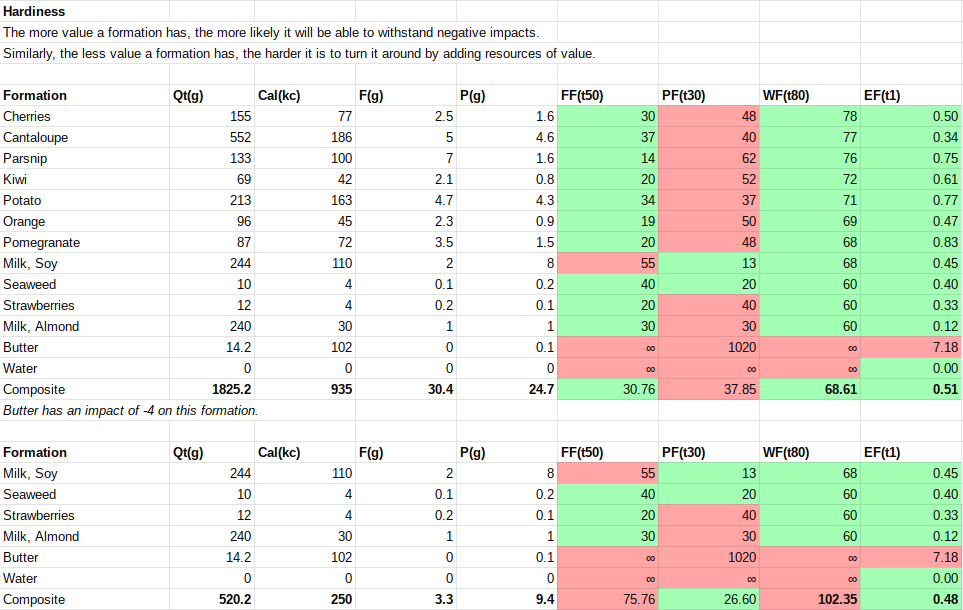
When we reduce the formation above, butter has a greater impact of -41.59.
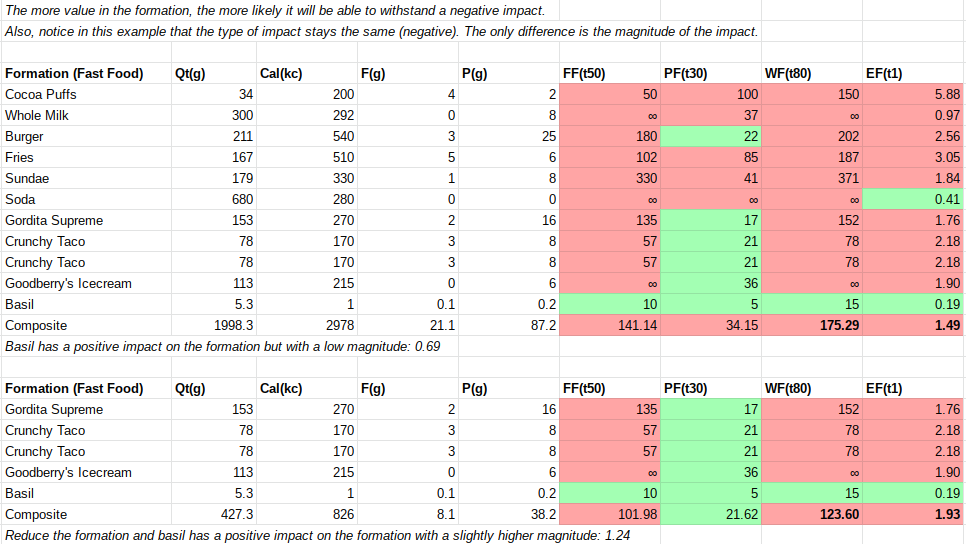
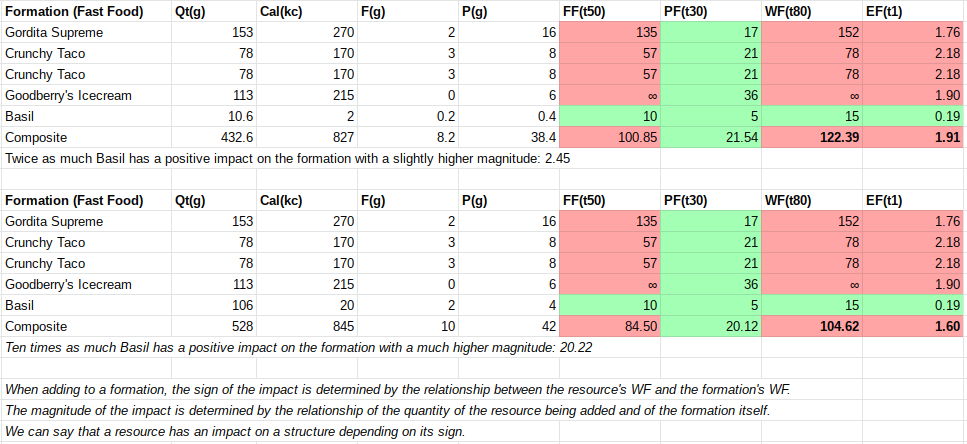
The Nutritional Equivalence Proof
This is my favorite proof because it shows that sameness (the same amount of fiber and protein) has more value than disparity, even when the total nutrition is the same:

The Wellness System Process
Getting Used to the Resource Map (first time)
When you first begin TWS, you might feel a bit overwhelmed. There are many terms and concepts that take some getting used to.
I recommend that you start out the TWS process with the resource map. After you browse the map, you will find certain foods that you will feel drawn to. You don’t need to create structures yet. Just use the map as a guide and explore consuming different resources.
Do this for about a week and see if you feel better. If you are happy simply perusing the resources map and you don’t have time to make structures, keep using the resource map as a guide. Whatever works best for you is what you should do.
Practice Creating All Structures (first time)
If you decide that you want to continue with TWS, the next step is to practice creating structures. There are 6 types of structures and 2 subtypes.
First, get used to copying and pasting all the pieces for your structures. Make sure that the expression formulas translate properly. At first, don’t worry about the composite or tuning, just piece them together so you know what they look like.
Second, focus on the composite. Make sure that the composite is summing all the components and the composite expression is transforming the components into metrics.
Once you know how to put them together, it’s time to start applying logic and balancing your components. Make sure that a structure’s expression is all green before you consume it.
Lastly, start consuming the structures that you put together. Take your list to the grocery store. When preparing your meal, use your food scale to make sure your portions are exact.
As you consume your structures, you will learn certain things about certain resources, for example, spinach wilts so you can use a lot of it. Also, you can restrict your meat to 100g.
Determine What You Want to Change
Determine the problems that you are trying to overcome. The next step is to decide what to change in order to solve those problems. For example, if you don’t like having to add the composites of 3 formations every day, you can decide to change to a grid. Or if you want to start tracking your water consumption, you can create an extension.
Apply Your Changes by Refactoring Your Structures
Once you’ve decided what you want to change, make the corresponding changes to your structures. Archive your formations and start tracking with grids. Add an extension row for water to every grid. This will change how you interact with the system. This exploration is about figuring out how the system works best for you.
Formulate a Strategy (first time)
The core of TWS is to create and maintain your own personal wellness strategy. Once you’ve been using it for about a month, it’s time to create a strategy. The terms “strategy” and “diet” are equivalent in TWS.
A goal is where you are heading. In TWS, the goal is wellness. A strategy is how you get there. Here are some example strategies:
Basic Strategy:
- Eat mostly plant-based foods
- Eat three small meals a day
- Drink plenty of water
TWS Strategy:
- Create structures every day
- Micro-fast in the morning
- Measure structures out and cook them accordingly
- Drink plenty of water
As you can see, there are some key differences between these two strategies. The first strategy tells you what you can consume. It also tells you how much you can consume. Most people would find this diet simple to use, however, it might not be the best solution for your body.
The second strategy is different. It does not tell you what you can eat. It tells you how to determine what you can eat. By creating structures every day, you are deciding what you want to eat. The system enhances your choices, making sure that your strategy is as good as it can possibly be. This strategy has a better chance of maintaining long-term because it can adapt with you.
Evaluate Your Strategy Periodically and Adapt If Need Be
I suggest that you write down your strategy and keep it in a safe place. Evaluating and adapting your strategy is an important part of TWS.
For example, I used to consume oatmeal every morning for breakfast. Then, I’d switch to cereal, then back to oatmeal. Eventually, I realized that eating oatmeal or cereal wasn’t helping me lose weight. This was 300-400 Calories every day which adds up to about 3lbs per month.
So instead, I adapted my strategy by introducing a micro-fast. So, now I drink nothing but juice for breakfast, and that’s it.
Continue the TWS cycle
Once you’ve adapted your strategy and started using it, eventually, you will find that you must return to Determine and continue the process again. This keeps TWS a living thing and helps you to get the most out of it.
Determine, Apply, Evaluate, Adapt
Glossary
- Analysis
- The process of organizing structures in a manner that reveals universal truth.
- Archive
- The tab used for storing structures, particularly formations and grids. Over time, your archive will become useful for its searchability.
- Autonomer
- A resource that has a W<80, and an E>1. Wants mass. Gives nutrition and energy.
- Axiom
- The basic unit of information, assumed to be true. The resource is composed of a designation and 8 numbers all of which don't need to be proved.
- Calories (c)
- The basic unit of energy used in the system (kc). It is the second component in a resource. It's the only component that isn't in grams. It's used in all metrics.
- Collection
- The collection is a group of resources, resource groups, or spaces that combine to form a higher structure.
- Complete
- A complete resource is one that is well-defined, meaning there are no missing components or metrics.
- Components
- The components are the 4 numbers that populate the center of a resource. They are the amounts lifted from the resource's nutritional information. They are used to compare to your daily ranges. The expression is derived from the relationships formed by the components.
- Composite
- The row in a formation or grid that serves as an aggregate to the collection. Balancing the composite is the heart of TWS. It tells you the overall amounts and nutritional value of what you eat and drink over the course of a day.
- Cost Value
- Cost Value is a resource extension that explores the relationship between nutritional value and cost.
- Definition
- A structure made of a header, a collection of resources, a composite row, and a seed. This looks like a formation with an extra row at the bottom. The seed should contain no formulas so it can be reused freely. Definitions are designed to simplify a large group of resources (usually a recipe) by condensing them into one "nested" resource. Seeds have a bold designation so you can distinguish a seed from a normal resource. The downside is that if the definition changes, all the seeds will be deprecated. The bests solution is to always pull the seed from the definition so it is always current.
- Designation
- The name of a resource.
- Diffuser
- A resource that has a W>80, and an E<1.
- E
- The energy metric is the relationship between a resource's Calories and its mass. This number is equivalent to the energy density, however the E is inversely proportional. Foods with a low E have a large amount of mass and a small number of Calories. Foods with a high E have a low amount of mass and a high amount of Calories. Thus, a lower E is desirable and a high E is not.
- Energized Supernutrion
- A resource that has a F<50, a P<30, a W<80, and an E>0.5 and <1. An energized supernutrion is a type of nutrion. Inert. Wants nothing. Perfectly balanced. Gives nutrition and mass.
- Energized Diffuser
- A resource that has a W>80, and an E>0.5 and <1. An energized diffuser is a type of diffuser. Wants nutrition. Gives mass.
- Energized Nutrion
- A resource that has a W<80, and an E>0.5 and <1. An energized nutrion is a type of nutrion. Inert. Wants nothing. Adequately balanced. Gives nutrition and mass.
- Energizer
- A resource that has a W>80, and an E>1. Wants nutrition and mass. Gives energy.
- Energy Density
- This is the relationship between a resource's Calories and mass. The difference is in the interpretation of the meaning; a high energy density is a low energy value, and a low energy density is a high energy value.
- Energy Value
- This is the relationship between a resource's Calories and mass. The difference is in the interpretation of the meaning; a high energy density is a low energy value, and a low energy density is a high energy value.
- Evaporation Mass
- The mass of water that results from evaporation during cooking. Evaporation mass can be counteracted by drinking water to replace it.
- Expression
- The expression is made of the 4 numbers on the right side of a resource. It is derived from the relationships of the components. It is designed to measure the value of the resource in 4 ways: fiber value, protein value, wholeness (overall nutritional value), and energy value. It is used to estimate the value of a large collection of resources and for comparative analysis.
- Extension
- Adding any number of columns to the resource structure in order to create additional meaning. For example, cost value is an extension that explores the relationship between nutritional value and cost.
- F
- The fiber metric is the relationship between Calories and fiber. Foods with a low F have a large amount of fiber and a small number of Calories. Foods with a high F have a low amount of fiber and a high amount of Calories. Thus, a lower F is desirable and a high F is not.
- Fiber (f)
- For the scope of this system, "fiber" always refers to "dietary fiber". It is one of the cornerstones of this system, as most people don't get nearly enough fiber. Fiber value is the relationship between Calories and fiber.
- Fiber Value
- Fiber value is the relationship between a resource's Calories and its fiber. It is measured by the F and is part of every resource's expression.
- Formation
- A structure made of a header, a collection of resources, and a composite row. Formations are used primarily for meal tracking and portioning. There are three types of formations: basic, portioned, and portioned list.
- Grid
- A structure made of a header, a collection (resources, resource groups, and spaces), and a composite row. The grid is similar to a formation but it is designed for two things, condensing formations and resources into one single, daily structure and providing a flexible collection for people who don't eat discrete meals or grazers. The only downside is that they don't do portioning well. Use a formation for portioning.
- Header
- Information that marks the labeling of data. A header tells you what you are looking at and aids in readability and interpretation of data.
- Healthy
- A resource or composite that has a W below 80 and an E below 1 is said to be healthy.
- Impact
- A resource's impact is mathematically the difference between it's W and the W of a composite. The impact is relative to the composite that it is being added to. For example, if a resource's W is 10 and the composite's W is 100, the resource will have a positive impact on the composite. The magnitude of the impact depends on the magnitude of the difference between the two W.
- Importation
- The process of adding a new resource to your personal resources map.
- Incomplete
- An incomplete resource is one that is not well-defined, for example, meat are all incomplete resources because they lack fiber. A zero component causes a metric to be infinite.
- Integration
- The process of converting all components into grams. Integration is part of the importation process.
- List
- A structure made of a header and a collection of resources, usually sorted for comparative analysis.
- Map
- A structure made of a header and a double list (complete, followed by incomplete). The first list is sorted by W (lowest to highest) and the second by E (lowest to highest).
- Mass (m)
- Mass is the "amount" of a resource. It is never 0 so the E can never be undefined. Mass combines with c to form the metric E.
- Metric
- A number defined by a formula that shows something meaningful about a resource. For example, the F (Calories/Fiber) tells the fiber value of a resource.
- Micro-fasting
- A micro-fast is a fast except for extremely small amounts of food or water. Fasting can be dangerous to the body because you are withholding energy. Micro-fasting is safer because you allow for small amounts of food and water. An example of a micro-fast is to drink half a glass of juice for breakfast and 2 slices of Canadian bacon for lunch. Your body is getting energy and protein with the benefits of a fast (teaching your body to be efficient).
- Nested Resource
- A resource made by a definition (seed). It contains the information from a collection of resources. It is prone to deprecation but simplifies a commonly used resource group.
- Nutrion
- A resource that has a W<80, and an E<1. Wants energy when E is <0.5. Gives nutrition and mass.
- P
- The protein factor is the relationship between Calories and protein. Foods with a low P have a large amount of protein and a small number of Calories. Foods with a high P have a low amount of protein and a high amount of Calories. Thus, a lower P is desirable and a high P is not.
- Protein (p)
- Protein is the other cornerstone of this system (fiber is the other). Protein is essential for a number of beneficial factors in your body. Protein value is the relationship between Calories and protein.
- Protein Value
- Protein value is the relationship between a resource's Calories and its protein. It is measured by the P and is part of every resource's expression.
- Reinforcers
- A reinforcer is a resource that is exceptionally rich in value and used specifically to impart value to a structure. For example, blackberries impart fiber, pumpkin seeds impart protein, and water imparts mass.
- Resource
- A food or drink item composed of a designation, components (4 amounts), and an expression (4 metrics). Resources are the building blocks of TWS.
- Resource Group
- A set of adjacent resources as in a formation or grid. A formation has one global resource group. A grid usually has multiple resource groups separated by spaces.
- Seed
- The bottom row of a definition. It is a nested resource. Use the seed as part of a formation or grid.
- Sort
- The sort is the column by which a structure is sorted. For example, a map is a double list, the first sorted by W, the second by E. Analysis usually uses sorting to prove that something is true.
- Structure
- A discrete batch of information organized to serve a purpose. There are 6 structures: resource, list, formation, definition, grid, and map. The resource is the basic unit of information (axiom) and serves as the building blocks for all other structures.
- Supernutrion
- A resource that has a F<50, a P<30, a W<80, and an E<1. A supernutrion is a type of nutrion.Wants energy when E is <0.5. Gives nutrition and mass.
- System Worksheet
- The *.xlsx file that contains the necessary information to practice the system. The worksheet is the heart of the system, where you create structures.
- The Wellness System (TWS)
- A system that helps you to develop your own personal food strategy and achieve long-term wellness in weight loss and nutrition.
- TWS Process
- The TWS process is a cycle of steps that help promote the adaptation of the system over time. The cycle is: Determine, Apply, Evaluate, and Adapt. This is in place to help people identify problems in their diets that might creep in over time. Or if your strategy isn't working for some reason, you can always change it. Your strategy is meant to adapt with your lifestyle.
- W
- The wholeness factor is the sum of F and P and estimates the overall nutrition or wholeness of a resource. Foods with a low W have a large amount of nutrition and a small number of Calories. Foods with a high W have a low amount of nutrition and a high amount of Calories. Thus, a lower W is desirable and a high W is not.
- Wellness
- Anything that has a positive impact on the body, mind, and/or spirit contains wellness. Also, wellness is the ideal state of being brought about by seeking wellness in body, mind, and spirit.
- Whiteboard
- A tab used for creating structures, listing common resources, and listing reinforcers. Every day, I move the grid in my whiteboard to my archive and create a new grid.
- Wholeness (nutritional value)
- Wholeness, or nutritional value, is the sum of a resource's fiber value and its protein value. It is measured by the W and is part of every resource's expression.
Legal Disclaimer
I am not a doctor or a dietitian. The information I provide is based on my own personal weight loss and nutrition journey. Any recommendations I may make about weight training, nutrition, supplements or lifestyle, or information provided to you in person, through my service, or on this website should be discussed between you and your doctor because changing your eating habits and working out involves risks. The information you receive in my emails, programs, services and products do not take the place of professional medical advice. I aim to accurately represent the information provided in my e-mails, programs, services, and products. You are acknowledging that you are participating voluntarily in using any of my e-mails, programs, services, and/or products, and you alone are solely and personally responsible for your results. You acknowledge that you take full responsibility for your health, life and well-being, as well as the health, lives and well-being of your family and children (born and unborn, as applicable), and all decisions now or in the future. Before starting any new diet and exercise program please check with your doctor and clear any exercise and/or diet changes with them before beginning. I am NOT a doctor, nutritionist or registered dietitian. I do not claim to help cure any condition or disease. I do not provide medical aid or nutrition advice for the purpose of health or disease nor do I claim to be a doctor or dietitian. Any product recommendation is not intended to diagnose, treat, cure, or prevent any disease. My statements and information have not necessarily been evaluated by the Food and Drug Administration. I expressly disclaim responsibility to any person or entity for any liability, loss, or damage caused or alleged to be caused directly or indirectly as a result of the use, application or interpretation of any material provided to you as the client. Individual results are not guaranteed and may vary. We cannot and do not guarantee that you will attain a specific or particular result, and you accept the risk that results differ for each individual. The health, fitness, and nutrition success depends on each individual’s background, dedication, desire, and motivation. As with any health-related program or service, your results may vary, and will be based on many variables, including but not limited to, your individual capacity, life experience, unique health and genetic profile, starting point, expertise, and level of commitment.